This was a lot of fun, and turned out to be a community efforts in some ways. A lot of people helped in the production of this event.
Thanks to everyone!


 I recently came across this article on Center for a Just Society. In the days leading up to the passage of the emergency bailout package, politicians from both parties warned everyone that what was at stake was our American way of life, and without massive intervention the country and perhaps the world was heading toward an "economic apocalypse."
The author states,
I must admit that I am skeptical when powerful folks ask for more power. I'm even more skeptical when they do so using fear as a motivation.What follows in the article is a series of questions about the ethical issues related to the current financial crisis. Some of the questions are more pertinent than others, but I think that we need to carefully think about them. For example, here is the first question:
1. Is it a fundamental problem when a corporation becomes so big that its failure threatens to bring down the national economy? Could it be that scale matters? Can institutions become so large that their potential harm outweighs their actual (or occasional) good? If yes, then are there measures that could help ensure that economic power is decentralized and therefore less dangerous?An example of this is, according to a CNN report, if the Big Three carmakers were to cut U.S. operations by 50%, 2.5 million jobs could be lost in 2009.
I think the premise of this question is valid, and even necessary to ask. Many people believe that the standard of living is a reward for living in the U.S., or at the least a quid pro quo relationship.
2. The bailout was ostensibly necessary to protect our "American way of life." That such a reason was offered without justification indicates that our way of life is an axiom that must be assumed but never questioned. But is it too much to consider, if only for a moment, that perhaps our way of life is precisely the problem? Of course, a way of life is a complex thing, but insofar as the "American way of life" consists in living beyond our means, it is unsustainable. To the extent that consumer credit is at an all-time high and personal savings is at an all-time low, the "American way of life" is irresponsible.My answer as to whether or not this is part of the cause of the financial crisis we are currently experiencing is an unequivocal YES.
The next two questions are questions we do need to answer:
3. Public debt mirrors private debt. Both publicly and privately, we have become a nation that demands immediate gratification. Is such a national disposition healthy? Psychologists tell us that adults are capable of delaying their gratification. If so, then publicly and privately we are, according to this measurement, behaving like a nation of children.From my seat in the upper bleachers, it seems that many other people are beginning to be aware of these questions as well, which may help to explain why Obama won and not McCain. McCain campaigned as if there were no problems, while Obama said we need change. If we ask Ronald Reagan's question, are you better off than you were four years ago, then we know what the answer will be.10. In Greek drama hubris plays a key role. This is the fatal pride that brings down even the greatest of men. Is hubris at the heart of this crisis? Hubris is the failure to acknowledge limits. It is the failure to live within the bounds proper to human beings. Ultimately, it is a failure of virtue. When we delay payments rather than our gratification, we reveal our ill-formed character. When our demands for more things are limited only by our insatiable imaginations, vice is running the show. When our leaders tell us that they can solve any crisis if only we grant them more power, hubris has taken center stage.
As I have said before, it is not that the question of abortion and the like are not important, it is that there are other questions out there that people see as important, and also need to be answered.
A person's stance on an issue may not qualify them to run or public office, but it does seem to be able to disqualify them.
Then Deborah said to Barak, “Get ready! This is the day the Lord will give you victory… for the Lord is marching ahead of you.” So Barak led his warriors down the slopes… into battle.
Judges 4:14
 A Christian Response to the 2008 Presidential Election
I have a couple of observations that I want to comment on.
1. Election Rhetoric.
It struck me that much of what republicans and democrats are saying about this election is much the same as what came out of the mouths of republicans and democrats in 2000 and 2004. Only this time, the remarks have switched parties. For example, republican friends say that a large majority of the country do not agree with the views of the new president (The democrats said this in 2000 and 2004), while on the other hand, democratic friends are saying that the election returns give Obama a mandate for change; again, something that the republicans said in 2000 and 2004.
2. Many of my Christian friends prayed fervently for this election.
Obama won. Did God not answer their prayers?
Or, did God answer their prayers?
God is known to work out his will despite his people. If God did answer these prayers, what does that do to our theology? Still more, what does this say about our support for Barack Obama? I don't want to be put into the situation of second guessing God. My guess is that there is a lot of change in the air, and we have to decide for whom the church will be a handmaid. What if Obama is the gate through which we need to walk in order to bring change to this country and stave off judgment?
3. Election Issues.
There are a lot more issues in this presidential election that are as important as abortion and homosexuality, but evangelicals are shy to address. For example, approximately 30,000 people die of starvation, waterborne diseases and AIDS each day, deaths which are viewed as preventable, yet I am only now beginning to see organizations such as Feed My Starving Children gain visibility. I guess what I'm trying to say is that we better be certain that we don't react to what God is doing when Rhoda comes to tell us that Peter is at the door (Acts 12:12-17).
4. I am astonished at the amount of negativity coming from the mouths of Christians!
Come on people, we are people of hope. The elections are important, but let's focus, okay?
Having said all this, the point of this post is this: We need to stop moaning and beefing about who won the presidency, and pray just as hard for the success of this man in God's will as we did for the whom we thought God wanted as president during this election campaign.
Here are two parts of a post by by Mark Roberts that speaks to the issue of how to pray for the election and the new president (here and here). I like what he says in his first point:
We Should Act Upon the Call of Jesus to Peacemaking in the Way We Relate to Our Fellow Citizens.

(Posted using ShareThis)
 There are times that I am embarrassed to be a follower of Christ. It is NOT that I am embarrassed of my LORD, but because of some of the people with whom I am on the journey. And that's too bad, it saddens me. Before anyone picks up cudgels to bludgeon me, please read through to the end of the article to see what I have to say.
 I think it is appropriate to pray for the economy. After all, God said to Jeremiah,
"Seek the welfare of the city where I have sent you into exile, and pray to the Lord on its behalf, for in its welfare you will find your welfare" (Jeremiah 29:7).
When the economy is strong, people are able to work and support their families, believers have greater opportunities for generosity, and many benefit from this common grace.This fits in well with Paul's idea of living in peace with everyone and other sentiments in Romans 13, among other things.
We can pray for integrity and wisdom for government officials who are faced with the incredibly complex task of regulating investment securities and banks in a way that is transparent and serves all of the varied stakeholders. We can pray that those who are willing to work will be able to find gainful employment. We can pray that greed would be restrained at all levels, from the leaders on Wall Street to individual families tempted to live beyond their means. We can pray for ourselves that we will participate in the national economy that keeps in mind the time is short and the present form of this world is passing away (1 Corinthians 7:29-31).
“And when you pray, do not be like the hypocrites, for they love to pray standing in the synagogues and on the street corners to be seen by men. I tell you the truth, they have received their reward in full. 6 But when you pray, go into your room, close the door and pray to your Father, who is unseen. Then your Father, who sees what is done in secret, will reward you. 7 And when you pray, do not keep on babbling like pagans, for they think they will be heard because of their many words. 8 Do not be like them, for your Father knows what you need before you ask him (Matt 6:5-8).I think this says that public spectacles may not necessarily be the best way to pray about an issue.
25 “Therefore I tell you, do not worry about your life, what you will eat or drink; or about your body, what you will wear. Is not life more important than food, and the body more important than clothes? 26 Look at the birds of the air; they do not sow or reap or store away in barns, and yet your heavenly Father feeds them. Are you not much more valuable than they? 27 Who of you by worrying can add a single hour to his life. Or single cubit to his heightIt seems that praying for the economy isn't about praying for our daily bread. It is about praying for Righteousness AND Justice. Righteousness is about our relationship with God; Justice is about our society's relationship with God.
28 “And why do you worry about clothes? See how the lilies of the field grow. They do not labor or spin. Yet I tell you that not even Solomon in all his splendor was dressed like one of these. If that is how God clothes the grass of the field, which is here today and tomorrow is thrown into the fire, will he not much more clothe you, O you of little faith? 31 So do not worry, saying, ‘What shall we eat?’ or ‘What shall we drink?’ or ‘What shall we wear?’ 32 For the pagans run after all these things, and your heavenly Father knows that you need them. 33 But seek first his kingdom and his righteousness, and all these things will be given to you as well. 34 Therefore do not worry about tomorrow, for tomorrow will worry about itself. Each day has enough trouble of its own (Matt. 6:25-34).
"I guess as a Christian I can't help but think of the bigger picture beyond just my own nation. And sometimes I wonder if God orchestrates these things to show us things. Like if Ireland and America and other well to do countries don't change their ways with regards to consumption and waste would we not end up in a situation where the poor are suffering as a result, or that they will never have the opportunity to live like we do?"Finally, a nice video by Max Lucado that's worth a look.

Moses received the Torah from Sinai and transmitted it to Joshua; Joshua to the elders; the elders to the prophets; and the prophets handed it down to the men of the Great Assembly. They said three things: Be deliberate in judgment, raise up many disciples, and make a fence around the Torah (Pirke Aboth, 1:1).Incidentally, the word translated fence is a mishnaic hebrew word (סיג) for wall, fence, or a thick hedge.
‘Woe to you, teachers of the law and Pharisees, you hypocrites! You give a tenth of your spices—mint, dill and cumin. But you have neglected the more important matters of the law—justice, mercy and faithfulness. You should have practised the latter, without neglecting the former. You blind guides! You strain out a gnat but swallow a camel (Matt. 23:23-24).Speaking to the city of Jerusalem through the Prophet Isaiah, God likens the city of Jerusalem to the planting of a vineyard:
Let me sing for my belovedmy love-song concerning his vineyard:My beloved had a vineyardon a very fertile hill.He dug it and cleared it of stones,and planted it with choice vines;he built a watchtower in the midst of it,and hewed out a wine vat in it;he expected it to yield grapes,… (Isaiah 5:1-2)
...but it yielded wild grapes (Isaiah 5:2b)The wild grapes, according the metaphor, are the sins and unrighteous acts of the people:
For the vineyard of the Lord of hostsis the house of Israel,and the people of Judahare his pleasant planting;he expected justice,but saw bloodshed;righteousness,but heard a cry! (Isaiah 5:7)
And now I will tell youwhat I will do to my vineyard.I will remove its hedge,and it shall be devoured;I will break down its wall,and it shall be trampled down. (Isaiah5:5)
Sort of reminds me of Nehemiah’s instructions to carry a sword in on hand and trowel in the other (Nehemiah 4:16-18).10 Finally, be strong in the Lord and in his mighty power. 11 Put on the full armor of God, so that you can take your stand against the devil’s schemes. 12 For our struggle is not against flesh and blood, but against the rulers, against the authorities, against the powers of this dark world and against the spiritual forces of evil in the heavenly realms. 13 Therefore put on the full armour of God, so that when the day of evil comes, you may be able to stand your ground, and after you have done everything, to stand. 14 Stand firm then, with the belt of truth buckled round your waist, with the breastplate of righteousness in place, 15 and with your feet fitted with the readiness that comes from the gospel of peace.
16 In addition to all this, take up the shield of faith, with which you can extinguish all the flaming arrows of the evil one. 17 Take the helmet of salvation and the sword of the Spirit, which is the word of God. 18 And pray in the Spirit on all occasions with all kinds of prayers and requests. With this in mind, be alert and always keep on praying for all the Lord’s people (Ephesians 6:10-18).


 Nate
NateAfter Bailout, AIG Executives Head to Resort
UPDATED: 11:31 a.m.While AIG was at the bar begging and drooling for money, this is one of the things that AIG did to battle the crisis:
Less than a week after the federal government offered an $85 billion bailout to insurance giant AIG, the company held a week-long retreat for its executives at the luxury St. Regis Resort in Monarch Beach, Calif., running up a tab of $440,000, Rep. Henry Waxman (D-Calif.) said today at the the opening of a House committee hearing about the near-failure of the insurance giant.
Showing a photograph of the resort, Waxman said the executives spent $200,000 for rooms, $150,000 for meals and $23,000 for the spa.
"Less than a week after the taxpayers rescued AIG, company executives could be found wining and dining at one of the most exclusive resorts in the nation," Waxman said. "We will ask whether any of this makes sense. "
Those documents show that as the company's risky investments began to implode, the company altered its generous executive pay plan to pay out regardless of such losses.This is like having overdraft protection on your checking account without worrying about having to repay it if you do overdraw.
 This is the subhead of an article on the BBC News website.
"The head of failed US investment bank Lehman Brothers has told Congress that he took home about $300m in pay and bonuses over the past eight years."There are other little gems in this article, such as:
"Mr Waxman also criticised Mr Fuld for requesting multi-million dollar bonuses for departing executives just days before last month's collapse."
"In other words," he added, "even as Mr Fuld was pleading with [Treasury] Secretary [Henry] Paulson for a federal rescue, Lehman continued to squander millions on executive compensation."I can think of a couple of things that might have caused "what went wrong".
"To restore our economy to health, two steps are necessary," he said. "First, we must identify what went wrong. Then we must enact real reform of our financial markets."
Along the same vein, check out this chart in the NYTimes. (HT to Nate)US Democratic presidential candidate Barack Obama has attacked John McCain's links to a 1980s financial scandal.He also accused his Republican rival of being more focused on running a smear campaign than on fixing the US economy.
It comes after Mr McCain's running mate Sarah Palin accused Mr Obama over the weekend of associating with terrorists.

Found this video on a website called Connaitre Dieu. It is a great metaphor for the love of God.
 No, I'm not leaving France, but I am moving my blog to my own domain. You can find it here, but there are only a couple of things there right now which you can probably find here as well. I will probably take a couple of months to switch, but I will keep posting here until I get the whole thing set up.
 In a previous post I shared a discussion I had with someone about the idea of missions in the church.
I want to take another look at one of these points:
4. The French, the .... (fill in the blank) had their chance.
The premise is that France, Europe, etc., has had a chance to hear the gospel but rejected it, so now we want to go where they will be open to the gospel.
My question is, where would that be? Europe has rejected the gospel, yes, but it is responding to it, though slowly. As my wife has also pointed out, when exactly did the French reject the gospel? In the eighth century? 17th century? During the French Revolution? Recently? Did everyone do it? Just a few? Did someone pass a law to that effect?
How about China, they've rejected the gospel, shall we cross them off our list? China is closed, but it was a major missions field until the communist takeover in 1949. The new government then expelled all Christian missionaries from their borders. Yet Christianity is growing rapidly.
Perhaps Eastern Europe? It was closed to missionaries and the gospel for many years during the communist hegemony, but now it is once again open.
Or maybe the Middle East and North Africa? Everyone knows that people of Islamic background faith are resistant to the gospel, so perhaps we should not invest time and people to share the gospel with them?
If we shake the dust off our feet, and seek a place to go where people will be open to the gospel, I think that pretty much limits us to Antarctica.
And what of the United States? Is the gospel received in this country? I think it is obvious that the church is losing ground in the United States. Yet we are willing to plant new churches. According to the premise stated above, this seems counter-intuitive.
I find these facts interesting:
“Fifty-nine percent of U.S. congregations have fewer than one hundred regular participants, counting both adults and children; 71 percent have fewer than one hundred regularly participating adults”So, if we are consistent in following our original premise, why start a church plant when this country is rejecting the gospel? Aren't there enough churches now that we have to start a new one?
"10 percent of U.S. congregations—the largest ones—contain half of the nation’s churchgoers."
 As I sat having coffee with a friend, we focused on the idea of mission that seems to be prevalent in the church at large, and discussing what a healthy church in mission would really look like.
It is somewhat arcane, but the image of a church in mission that came to mind was a stool. A proper stool, as a high school industrial arts teacher once said, needs at least three legs if it is to be of any use. Otherwise, it will topple over. I think that the stool would look something like this picture to the right. 
As a metaphor, church mission is much the same. There are three legs, Outreach, Service, and Spiritual Formation. And of course, there needs to be a balance between the three legs for it to function effectively.
What happens when the stool has only two legs, or one of the three legs is not the right length, too short or too long?
This happens when outreach is a program, not balanced by service and spiritual formation, or when service takes the place of spiritual formation.
Unfortunately, I have seen all the above. Churches are great at getting people interested in visiting the church, but they can't get them interested in spiritual formation. Or they use service opportunities as a substitute for spiritual formation.
A church I visited had several excellent opportunities for community involvement in place, booths in the lobby to get people signed up and involved. But I saw no opportunities for spiritual formation. It seemed that the service opportunities were being used to bring people into the church and then getting them involved, assuming that it will cause spiritual growth.
Without belaboring the point, the REVEAL study has put the notion of involvement as an indicator of spiritual maturity in perspective:
We found that those who were the most active in the church did not necessarily report higher levels of spiritual attitudes (“love for God and others”) and spiritual behaviors (evangelism, tithing, etc.) than those who were less active (chart 2).
Part of the problem, or maybe even the root of it, is that churches do not understand what it means to be involved in missions, or, for that matter, what it is to be missional.
I have been wrestling with the issue of being missional and what it means to be emergent. I don't think they are synonymous.
It is easy to critique a church and its mission, another to give help and suggestions on how to make changes.
But that is for another post.
 According to Technorati, my rank is 2,639,653. I think that is somewhere down in sludge that the sump pump misses.
However, I did get a mention in Scot McKnight's Jesus Creed blog! (down a little where it starts with "A good blogger in France...).
That has to be worth something, right?

Found this on another blog. I love this. Not only a great prayer, it's great theology.
Praying with Walter Brueggemann.
We are your people and mostly we don't mind,
except that you do not fit any of our categories.
We keep pushing
and pulling
and twisting
and turning,
trying to make you fit the God we would rather have,
and every time we distort you that way
we end up with an idol more congenial to us.
In our more honest moments of grief and pain
we are very glad that you are who you are,
and that you are toward us in all your freedom
what you have been toward us.
So be your faithful self
and by your very engagement in the suffering of the world,
transform the world even as you are being change
We pray in the name of Jesus,
who is the sign of your suffering love. Amen.
 I recently had a discussion with a friend about missions in the church. Granted, he was talking about a specific church, but his comments reflect a common thought process and approach to missions in the emerging church.
  For my friend, that means that anyone who wants to go to a specific field can access it without a long flight or paying a lot of money for a ticket. Wouldn't that eliminate most of Europe, the Middle East, and much of Asia? Is accessibility to the field a major specification for missions?
 I will be the first to say that we are to use good stewardship, but does that dictate the shape of missions, and where we are to go?
  When the Holy Spirit was preparing for the outward expansion of the church, he spoke through the prophets in Antioch saying, "Separate Paul and Barnabas for the work to which I have called them (Acts 13)."
 The idea is that a specific area has been evangelized and had the gospel, but they rejected it, so we will go someplace where they will accept the gospel. I have had this said to me about France, and Europe in general. Yet is the place where the stirrings of the Spirit are evident.
 I have been told that the mission of the church needs to start where the church is located (i.e., Jerusalem), and then move to Judea and Samaria (outside your community), and finally into Europe, Asia, Africa, or where ever.
  Final Notes:
 10 your kingdom come, your will be done, on earth as it is in heaven. (Matt. 6:10)I think that drives our desire to reach out to the poor and marginalized is because we want to do something significant, to make a difference. My response to this can be best illustrated by something I heard Jim Plueddemann once say, which goes something like this:
Significance comes in obedience to God, as we seek to serve him. But the answer to how is yes.
We can do something SIGNIFICANT! for God, or
we can do something significant for GOD!
 My wife found this on line. It is a video for potty training children. It is in Japanese, with English subtitles.
  The Pew Forum on Religion and Public Life has recently released a report, U.S. Religious Landscape Survey. The report is worth a read for the info that it supplies about the American religious landscape. A lot of it is surprising, and as the report states,
...The Landscape Survey confirms the close link between Americans' religious affiliation, beliefs and practices, on the one hand, and their social and political attitudes, on the other. Indeed, the survey demonstrates that the social and political fault lines in American society run through, as well as alongside, religious traditions.
One section is worth pulling out for consideration:
Most Americans agree with the statement that many religions – not just their own – can lead to eternal life. Among those who are affiliated with a religious tradition, seven-in-ten say many religions can lead to eternal life. This view is shared by a majority of adherents in nearly all religious traditions, including more than half of members of evangelical Protestant churches (57%). Only among Mormons (57%) and Jehovah’s Witnesses (80%) do majorities say that their own religion is the one true faith leading to eternal life.
Most Americans also have a non-dogmatic approach when it comes to interpreting the tenets of their own religion. For instance, more than two-thirds of adults affiliated with a religious tradition agree that there is more than one true way to interpret the teachings of their faith, a pattern that occurs in nearly all traditions. The exceptions are Mormons and Jehovah’s Witnesses, 54% and 77% of whom, respectively, say there is only one true way to interpret the teachings of their religion.
I can imagine evangelicals and Christians of all stripes bending over this report, concerned about the direction and focus of religion in American (which is basically dropping dogma for spirituality).
There will undoubtedly be many initiatives to stave off and reverse this trend of faith in this country. Lack of faith on one side, and apathy and weak theology on the other is destroying our country, culture, ...(fill in the blank).
The problem is, of course that we see it as our battle, our problem, and probably our fault because Christianity is losing ground. If we can be more faithful, preach and witness more, proclaim the word, people will hear and turn and be saved.
Unfortunately, the problem is that all of this is simply getting in the way of the the work of the Spirit. I see more and more that Christianity in the US is more "Jesus lite."
The battle is not ours, it belongs to the Lord. We do not fight against flesh and blood but against principalities and powers (Ephesians 6:12).
What we have is managerialism imposed on the church, enthralled by systems thinking and programs that do not rest on faith, but reason and intentionality.
Image source:
http://www.post-gazette.com/pg/images/200708/20070828BizReligion_dm_500.jpg
 I'm a fan of REVEAL, the initiative started by Willow Creek. I think their findings concerning the reality of spiritual growth in the church are significant, and point to an issue that I have been
 harping preaching about for years.
The sources of the problem are largely the result of the descent of managerialism on the church. However, that is an issue for another post.
One of the five "key findings" of REVEAL is that there is not necessarily a correlation between commitment and church attendance, or community. This is what REVEAL reports:
We found that those who were the most active in the church did not necessarily report higher levels of spiritual attitudes (“love for God and others”) and spiritual behaviors (evangelism, tithing, etc.) than those who were less active.
This led us to discovering a Spiritual Continuum centered on a relationship with Jesus Christ, which was much more predictive of spiritual growth (Chart 3).
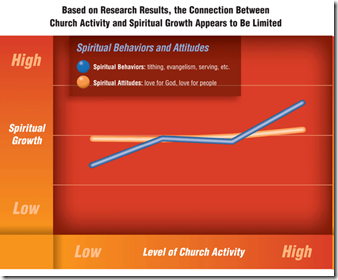
What I find interesting is that I missed the conversation going on in other quarters. I have a book I purchased a few years ago, long before REVEAL hit the stands, written by Joseph R. Myers, The Search to Belong.
In a chapter entitled "the myths of belonging (p9)," Myer writes:
More commitment = more belonging. People often believe that there is a significant relationship between commitment and community. That is, however, a romantic view. When we search to belong, we aren't really looking for commitment. We simply want to connect (p12).
I'm not saying that Willow Creek borrowed the idea, quite the contrary. When an organization as large as Willow Creek picks up on an issue that has been surfacing throughout the church,to say we are sensing a moving of the Spirit is a bit of an understatement.
This sentiment is also found in Rick Richardson's writings, such as Evangelism Outside the Box, as well as in the the halls of the emerging church.
So, what's next? That is the question that faces my colleagues and I in France. I'll get back to you.
 Interesting post found on Dr. Jim West's blog that I think is worth noting.
 My friend Marcus is his own brand of Renaissance Man. One of his many talents is his turn of a phrase to compose some very interesting poetry. His work ranges from some that are very good to some that are akin to Vogon poetry.
But on a more serious note, Brother Marcus sent us his latest work, which I think is worth a look. Here it is:
De-cursed, Rehearsed, Well-Versed : Snakeskin Boots
I've had some thoughts about this snake
who came and stole our birthday cake;
he spoke the truth, Eve did assume,
he came in light and left in doom.
He seemed so lovely, wholesome, pure,
but was a fake, that is for sure;
by God's command he bit the dust,
to crawl, not walk: this is a must.
Inherited by all who come:
a conscience broke and mostly numb;
a spirit dimmed with shadowed sight,
the truth forlorn midst shadowed night.
God cursed that snake, it was to be,
still cursed through all eternity;
a lake of fire: it waits ahead,
for snake of sin amidst the dead.
But Christ became a curse for me
by hanging there upon that tree;
I stare, I gaze with wonder filled,
this spirit soars, my heart is thrilled.
For cursed no more: that is my state,
redeemed and sealed: this is my fate;
the lamb was slain, the snake was stomped,
we praise the King's deliverance prompt.
O join with those whose snake is gone,
in praise of heart, yea praise in song;
for boots of snakeskin we will wear,
upon those streets with golden glare.
MWA; June 2, 2008
Picture Credit: http://hitchhikermovie.free.fr/images/vogon3b.jpg
 In the process of doing my preparatory study for a sermon on Psalm 107, I discovered a structure that runs throughout the entire Psalm. It looks like this:
 Psalm 107 | ||||
Situation | Cry to God | God’s Response | Summons to Give Thanks for Hesed | Result |
I. Deliverance 4 Some wandered in desert wastes, finding no way to a city to dwell in; 5 hungry and thirsty, their soul fainted within them. | 6 Then they cried to the Lord in their trouble, and he delivered them from their distress. | 7 He led them by a straight way till they reached a city to dwell in. | 8 Let them thank the Lord for his steadfast love, for his wondrous works to the children of man! | 9 For he satisfies the longing soul, and the hungry soul he fills with good things. |
II. Freeing the Prisoner 10 Some sat in darkness and in the shadow of death, prisoners in affliction and in irons, 11 for they had rebelled against the words of God, and spurned the counsel of the Most High. 12 So he bowed their hearts down with hard labor; they fell down, with none to help. | 13 Then they cried to the Lord in their trouble, and he delivered them from their distress. | 14 He brought them out of darkness and the shadow of death, and burst their bonds apart. | 15 Let them thank the Lord for his steadfast love, for his wondrous works to the children of man! | 16 For he shatters the doors of bronze and cuts in two the bars of iron. |
III. Healing and Forgiveness 17 Some were fools through their sinful ways, and because of their iniquities suffered affliction; 18 they loathed any kind of food, and they drew near to the gates of death. | 19 Then they cried to the Lord in their trouble, and he delivered them from their distress. | 20 He sent out his word and healed them, and delivered them from their destruction. | 21 Let them thank the Lord for his steadfast love, for his wondrous works to the children of man! | 22 And let them offer sacrifices of thanksgiving, and tell of his deeds in songs of joy! |
IV. Salvation from the Storm 23 Some went down to the sea in ships, doing business on the great waters; 24 they saw the deeds of the Lord, his wondrous works in the deep. 25 For he commanded and raised the stormy wind, which lifted up the waves of the sea. 26 They mounted up to heaven; they went down to the depths; their courage melted away in their evil plight; 27 they reeled and staggered like drunken men and were at their wits' end. | 28 Then they cried to the Lord in their trouble, and he delivered them from their distress. | 29 He made the storm be still, and the waves of the sea were hushed. 30 Then they were glad that the waters were quiet, and he brought them to their desired haven. | 31 Let them thank the Lord for his steadfast love, for his wondrous works to the children of man! | 32 Let them extol him in the congregation of the people, and praise him in the assembly of the elders. |

