 I recently had a discussion with a friend about missions in the church. Granted, he was talking about a specific church, but his comments reflect a common thought process and approach to missions in the emerging church.
My friend told me that there were several parameters for the missions focus of the church, such as:
1. The mission field had to be accessible.
 For my friend, that means that anyone who wants to go to a specific field can access it without a long flight or paying a lot of money for a ticket. Wouldn't that eliminate most of Europe, the Middle East, and much of Asia? Is accessibility to the field a major specification for missions?
When the Holy Spirit said to separate out Paul and Barnabas for a mission, was it based on accessibility of the mission field to Paul and others? Did the HS only send them to places where they found it easy to go? Mission history abounds in stories of people such as Hudson Taylor, Adoniram Judson, David Brainerd and others who gave up family, friends, and secure lives to go to proclaim the gospel, at great personal cost to them. Judson, for example, spent months traveling to Burma, a country closed to the west, only to be thrown into prison by a government that was suspicious to him and reasons for being in Burma.
As for Paul, there were times when he wanted to go somewhere, and the HS did not allow him to go at first (Acts 16:6-10), in addition, the times Paul suffered for the sake of the gospel (2 Corinthians 11:23-33) would seem to have an impact on the accessibility of the field.
For whom is the mission field to be accessible? Everyone in the church? A few chosen individuals?
I don't believe that accessibility be a primary specification for mission.
2. Biggest bang for the buck?
 I will be the first to say that we are to use good stewardship, but does that dictate the shape of missions, and where we are to go?
Again, cost was not the dictating factor for Paul and Barnabas. The Holy Spirit sends and provides the means to do so. It is not that we should obsess over the money, but how we follow the leading of the Spirit. I don't think we do this by setting up parameters and hurdles to force the Spirit to do and work as we want, based on budget considerations.
3. Is it Mission Field or Missionary?
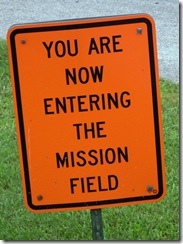 When the Holy Spirit was preparing for the outward expansion of the church, he spoke through the prophets in Antioch saying, "Separate Paul and Barnabas for the work to which I have called them (Acts 13)."
As for Jesus, he told his followers, “As the Father has sent me, I am sending you” (John 20:21). When we look at the the various forms of the great commission, the focus for mission is obedience, The specific area mentioned is the world, not one geographical location.
The Spirit did not ask the church in Antioch to separate out a mission field, but a missionary. Is our emphasis on a field backwards? Or do we send people out to the field whom God has called? I think so.
4. The French, the .... (fill in the blank) had their chance.
 The idea is that a specific area has been evangelized and had the gospel, but they rejected it, so we will go someplace where they will accept the gospel. I have had this said to me about France, and Europe in general. Yet is the place where the stirrings of the Spirit are evident.
First, who gives anyone the right to pass judgment by saying they had their chance, now it's too late? I was under the impression that God does not want anyone to be lost, but to have the fullness of life, and have it abundantly?
And where will you go? Somewhere (like Nigeria, for example...??) where they will receive the gospel? Nigeria is over 55% Christian (by their profession), but it is also a very materialistic church that is submerged in the culture and compromised by it, not unlike the United States.
There are other places to go, China is a large potential area for the gospel, but there are issues of accessibility for these areas. China, Burma, Vietnam, and other areas are closed to missionaries.
5. Go Make Disciples

I have been told that the mission of the church needs to start
where the church is located (i.e., Jerusalem), and then move to Judea and Samaria (outside your community), and finally into Europe, Asia, Africa, or where ever.
The problem is that the various passages tagged as part of the Great Commission are often seen as a linear process, i.e., start where you are, then go out from there. Unfortunately, the result of this is that this is taken to mean that we need to plant ourselves and be fruitful and successful at one level before we progress to the next. So, we need to fully evangelize, preach, teach, feed, clothe, etc. in one place before we move to the next.
I doubt we can build a case for this either theologically or linguistically. The Greek text behind
Acts 1:8 does not support a progressive or "step by step" plan for evangelism. There are several good ways of understanding the conjunction
καὶ (usually translated as "and"), but the best way to understand the use of
καὶ in this passage is as a coordinating conjunction with an ascensive function, a
point of focus, as Wallace comments (
Greek Grammar Beyond the Basics, p 761). The focus of the passage is the whole world, as
Matthew 28:19 points out.
Theologically, Matthew 28 states that we are to make disciples of all nations. The command is holistic, not fragmented into parts or agendas. That is modern management practice.
Another story that illustrates this very nicely is the persecution in Acts 8. The church was busy hunkering down in Jerusalem when a persecution breaks out and pushes them out of Jerusalem into Judea and Samaria, and by implication, Antioch in Syria. It was the intent of the Holy Spirit that they move out into the world. Left to their own devices, the church would probably only be reaching Greece today.
I am also impressed by the fact that Jesus chose to go throughout all the villages and towns of Galilee, not picking out one town and set up a ministry there. Paul was sent out by the Spirit, first to Asia Minor, then to Greece and finally to Rome. Did he evangelize all the areas in between, therefore he needed to move on to the next mission field?
So, I don't think we can build a case that we have to set down a base in one place, overwhelm it with the gospel, then move on to the next area.
So, being sent, being missional, or whatever we choose to call it, is not what we often make of it.
 Final Notes:
Please don't think that I am against serving the poor, oppressed, marginalized, or social justice. Anyone who knows me will testify to my vision of the rule of the Kingdom in our lives. I believe in righteousness and justice. Righteousness in the individual axis of our relationship with God, and justice is the community or social aspect of our relationship with God.
I don't know quite how to verbalize the disconnect I mentioned above, but I think the issue of the focus of missions/missional breaks down into
call and vocation (what we do?), which focuses on making disciples of all nations, and
life in the kingdom (what we are?).
The intersection of these two trajectories are summarized in this petition from the Lord's prayer, which says:
10 your kingdom come, your will be done, on earth as it is in heaven. (Matt. 6:10)
I think that drives our desire to reach out to the poor and marginalized is because we want to do something significant, to make a difference. My response to this can be best illustrated by something I heard Jim Plueddemann once say, which goes something like this:
We can do something SIGNIFICANT! for God, or
we can do something significant for GOD!
Significance comes in obedience to God, as we seek to serve him. But the answer to how is yes.
Finally, to run missions through a grid like this pretty much pre-defines what the will of God would look like. It take the worry of faith as well, because you see by sight...


 No, I'm not leaving France, but I am moving my blog to my own domain. You can find it here, but there are only a couple of things there right now which you can probably find here as well. I will probably take a couple of months to switch, but I will keep posting here until I get the whole thing set up.