Showing posts with label Bible. Show all posts

11 October 2015

Community: “Why Should Christians Live in Community in the Church?”

A sermon by Claude Rouviere, 11/Oct/2015
community-Claude

Outline
•Early church community as a 'model’ (Acts 2, 42-47)
•Why community?
•Brothers and sisters, not friends
•Community is not THE aim

« They devoted themselves to the apostles' teaching and to fellowship, to the breaking of bread and to prayer. Everyone was filled with awe at the many wonders and signs performed by the apostles. All the believers were together and had everything in common. They sold property and possessions to give to anyone who had need. Every day they continued to meet together at the temple courts. They broke bread in their homes and ate together with glad and sincere hearts, praising God and enjoying the favor of all the people. And the Lord added to their number daily those who were being saved. » (Acts 2, 42-47)
This well-known text describes the first fellowship of believers and gives us a model of how the Church should be but it seems that most communities have drifted from this over centuries.
Francis Chan wrote in ‘Crazy Love’ : « We all know that something is wrong. In the beginning I thought I was the only one concerned. Until the day I asked this question to twenty thousand Christian students : « How many of you, after reading the New Testament, wonder if you haven't missed something? » Almost everyone raised their hands and I was suddenly reassured. At least, I was not crazy »
The life of the early Church could sound like a dream but the Bible never says that there was an early church and then another one. There is only Christ’s Church and God’s Word says all we need to know to be what He wants.
A first point is self-evident from the beginning of this chapter even if Luke didn't think that it was necessary to remind us of it : this Church is born from Pentecost ; it lives fully in the power of the Holy Spirit. To restore confidence in the Holy Spirit, to let Him have all the authority in the Church seems to me the first essential step to come back to the Church that God wanted. But this could be a whole sermon in itself !
This early Church was clearly a community of life as shown by these words :
« everyone», « all », « together », « in common ».
When Jesus said « For where two or three come together in my name, there am I with them » he highlighted something very special about community in His name : it’s a refuge where His presence is assured in a very special way.
Believers lived fully in fellowship not only for spiritual activities. It was just in this manner that Jesus lived with the apostles and He used the word « brothers » to show in what way He wanted His disciples to live. This image of the family means care of one another, help, support, encouragement. Brothers and sisters share what they live ; the young learn a lot from the old … It is what Jesus desires for His Church.
Going to church is really not the same thing as going to the cinema ! It’s being part of a community where people know each other, trust each other, share the joys and difficulties of being a disciple. Everyone knows he can count on others whatever he needs.
But do we dare to revel our needs ? And what about calling for help ? Often we are afraid of bothering people But Jesus Himself called the apostles for help in the garden of Gethsemane. They were not very useful, that’s right but it was before the cross, the resurrection and the coming of the Holy Spirit that changed them ! But if we support each other especially with prayer, we will see God acting, we will be awed and we will grow up in faith.
No one is strong enough to face disciple life alone. They always will be dark days, days of discouragement when we will need to be reminded about God’s love and faithfulness ; days when we will have no more strength to pray and then others will support us with prayer and on the other hand, days when we will be happy to support and encourage others, sharing the mighty Works of God with them.
This text talks about prayer –and this too could be a whole sermon. Praying for others is good but praying WITH others is very important. This may be difficult for us because the language used in our Church may not be our mother tongue and it is difficult to pray in another language –unless one is perfectly bilingual- because often our heart goes faster than the translation ! And prayer needs to flow in liberty. This is something we could think about together in order to decide what we could do.
A friend shared something very interesting to me. She was at a prayer meeting and someone came with a Dutch friend. She didn’t speak French and so she prayed in Dutch. My friend didn’t try to understand because… it was impossible but she opened her heart to God and then a prayer came and she spoke it out loudly. The lady who came with the Dutchwoman said in her ear : « that is almost exactly what she said ». Prayer is not only human speaking and thinking. God is there !
But there is much more to fellowship as David said in Psalm 133 :
« How good and pleasant it is when God’s people live together in unity !
It is like precious oil poured on the head, running down on the beard, running down on Aaron’s beard, down on the collar of his robe.
It is as if the dew of Hermon were falling on Mount Zion.
For there the Lord bestow his blessing, even life for evermore. »
This very short psalm is fundamentally built around these words : « live together in unity » . Everything else describes this fellowship with the words « it is like », « it is as if »
First it is simply good and pleasant as said in verse 1, as human friendship can be but verse 2 compares it to the priestly anointing that was reserved for God. We must remember that some parts of the Temple were forbidden to those who had not received anointing.
In verse 3 the comparison with dew shows fellowship as a gift from God that brings freshness and life. It is rainwater and dew on Mount Hermon that gives life to the Jordan, the vein of life in this desert country
The last verse in a way, summarizes everything : « For there –in fellowship- the Lord bestows his blessing, even life for evermore ». If we simply « live together in unity » God can bestow on us « his blessing, even life for evermore » ! ! Have you ever thought about this ?
Could fellowship be a condition for blessing and abundant life ? Could God wait for His children to be united in communion to bestow His blessings ?
This is what David seems to be saying in this Psalm. As with salvation, God gives us the means to enter into the blessing of abundant life but we must accept them and put them into practice.
And this is not about well-being –not so easy to attain- in a small group of chosen friends but about spiritual communion with all the children of God, those who are easy to get on with and all others, even the ones who have hurt us, even those who don’t think the same about how and when Jesus will return : millenarian, premillenarian, postmillenarian, amillénarian… and even those who don’t care ;-)
Could we imagine that it was easier for the early Church ? That they were all kind and gentle ? Do you think that it was easy to live with Peter ? And with Paul ?
We are brothers and sisters because we have the same father. Let us not forget that Jesus taught us to pray « Our father », not « My father ». Why ? Perhaps because of the blessing and the abundant life. Love is not a choice, it’s a commandment.
Sometimes one of my sons came to me saying « he is not my brother anymore! » I explained to him that I understood his anger but that his brother will stay his brother forever. It generally was short but very painful for me. Could we imagine God’s heartbreak every time we find good reasons to avoid loving those who are also His children, not necessarily in our community but in the all Church ?
How can we say « Abba Father » without loving those who are our brothers and sisters in our father’s heart ? Remember : «  By this everyone will know that you are my disciples, if you love one another ». It’s easier to stick a fish on my car… Sometimes the attitude of the Church denies the gospel that it is supposed to announce. The world looks before listening…
Rodney Smith (English evangelist) wrote with great pertinence. : « They are five Gospels : Matthew, Mark, Luke, John and Christians. There are some people who have never read the first four »
The text of Acts 2 lists the activities of the early Church and its fruit. I also note a notion of discipline. The verb « to devote oneself » seems to be about the time spent while in Greek the verb indicates more a sustained effort that could be better translated by the word 'persevere'. It is not only a question of presence but it is about making progress, digging deeper, without giving up.
First « the apostles' teaching », the « fellowship », « the breaking of bread » -that could mean Holy Communion- and « prayer » result in « awe at the many wonders and signs». The word translated by « wonder » means in Greek « signs sent by the gods » and the one translated par « signs » speaks about marks which enable us to recognize, about proof. It’s a kind of stamp put by God in order to validate the witness of His Church.
Then, Luke describes the radical and visible commitment of this community : to have « everything in common », to « sell property and possessions », to « give to anyone who had need », to meet everyday at the Temple, again the breaking of bread, to eat together, the joy and praise that resulted in many conversions everyday.
But it is very important to note that God is always the one who acts : the community and the apostles don’t produce wonders or signs. They are only the means and the Greek word « dia » said precisely « through ». They are in no way the principal actors nor the subject of the sentence. It is written : «many wonders and signs happen through the apostles. ». The apostles are exactly like a pipe that drives water to a watering place.
You really need the pipe but it is only the water which quenches and gives life, not the pipe ! Take a pipe, even a new one, a very long one, you will never drink unless water flows through it.
This Church was in some ways the extension of the group of apostles. They lived together with Jesus, they shared the gospel everywhere they went. Jesus is no longer present physically but they aren’t alone ; He is still the centre, the reason for this fellowship, the strength and the light they need to continue the mission and Jesus is still acting through them BY the Holy Spirit.
Paul uses the image of the body. Jesus is the head. In what state is the body that we offer to him ? It seems to me that in this country, we give to him a heap of scattered limbs and organs. What can He do with this ?
Together, around Christ who continues to be, by the Holy Spirit, present and acting through them. It’s very simple and nevertheless not so easy because through the centuries the Church has slidden away from this model.
Could we try to see what could weaken the Church ?
Firstly, community can be such a soft and comfortable cocoon that the spiritual life of others comforts and is enough. No need to seek God. And then, gradually, professionals of the faith have been established (I don’t speak about ministries, but about faith) When Jesus died, the curtain of the Temple was torn from top to bottom but through the centuries, the Church mended it. The strength of the Church is not the number of attendants but the number of people entering God’s presence.
Community is a gift from God for believers and the world but the main danger is to build such a nice community only on human foundations where God is no more the centre nor the main actor. Also, good programs can be based only on human strategies, more like marketing than faith and their results will be very human and won’t show the power of God.
Another big risk is to give priority to activities (even very spiritual ones, even ones that help others) rather than to God himself. They could become idols, like the bronze serpent that Hezekiah must destroy because the people of Israel offered incense to him.
But no activity, even shown to the world in love will give sense to the Church. What I do FOR God will never replace what God wants to do IN us, THROUGH us. We are God’s instruments !
Finally, the image used most frequently in the Bible to express God’s Relationship with His people is the image of a couple. Could you imagine a husband who would like an intimate moment with his wife. She answers : « I do the shopping, I do all the cooking, I do all the washing, I take care of the children, I even help the neighbors… what more do you want ? » It makes you laugh ?
But we say this to God, very often… perhaps not in words but in facts.
No program could take priority over the time of love with God, the time on the mountain, in the tent of meeting, in the silence of prayer. Even with fasting. Individually but also together. Speaking about God will always be less important than listening to God.
Our deeds –even excellent- our work –even very hard- our perseverance are not the objective. Let us remember the letter to the Church in Ephesus :
« I know your deeds, your hard work and your perseverance… Yet I hold this against you : you have forsaken the love you had first » (Rev 2, 2-4)
We often understand the word ‘protos’ (first) as an indication of time (the love you had first) but in Greek, the main meaning is about priority, value, first place.
« I know your deeds, your hard work and your perseverance… Yet I hold this against you : you have forsaken to give me the first place in your love»
Jesus didn't blame this Church for its lack of good works but the lack of desire for Him. Religious activities can easily make us forget God or relegate Him to second place.
But loving God must take precedence over deeds and work !
I believe that the world will be transformed if –and when- the Church will come again to the absolute priority – the intimacy of a loving relationship with God.
The whole Bible tells us about God's desire for a loving relationship with us.
Do you know why we can find in the Bible such a surprising book as Song of Songs ?! So that we never forget God’s burning desire. A fiancé doesn’t desire that his fiancée does things for him but spends time with him. Do we dare to hear what the Bible says through this image of a loving couple that runs throughout all the Bible ?
How can we respond to God’s desire for us ? What we can do for Him will never replace in His heart what he wants to do WITH us, IN us ! This is how the the early Church lived.
If we dare to do the same, TOGETHER, then the world will see that He is God ! There will be wonders and signs and He will add daily to the Church those who will be saved !

26 February 2015

N. T. Wright and “The Way of the Wilderness”

way of pilgrimageI came across this meditation by N. T. Wright, based on his book The Way of the Lord: Christian Pilgrimage Today ( N. T. Wright, Wm. B. Eerdmans Publishing Co

The wilderness comes in many shapes and sizes, just as the deserts of Judaea and Sinai are by no means uniform. I used to think of deserts as simply miles and miles of flat sands, punctuated by the odd oasis; but the wilderness that surrounds the Promised Land comes in many forms. There are huge crags, like Masada, the last bastion of the revolutionaries after the fall of Jerusalem, an enormous barren rock to the south-west of the Dead Sea. There are gullies and crevasses, great rocky outcrops and hidden valleys. Walk a mile or two off the road and you could get lost quite easily.

The wilderness of the spiritual journey is much like that. For some, it is simply a sense that everything has gone very dry. There is no delight in prayer or reading the scriptures. Going to church has become boring and futile. The sacraments seem a pointless ritual. Where before there was a sense of God’s presence as a loving parent, gently nursing and guiding, or of the wise prompting of the Holy Spirit, there now seems to be a great emptiness. The story of Jesus, once so full of interest and stimulation, the scrap-book of the life of a new best friend, seems dull, and even the story of the cross and resurrection has apparently lost its power to sweep the heart. This is the common experience of many, many Christians at some stage in their pilgrimage. Tragically, some at once conclude that what happened at the Jordan was all a delusion, a passing phase, that there really is no Jerusalem to go on to. Others wander blindly without hope, and stumble by accident — or was it an accident? — back on to the right path. But the way of Christian maturity is to recognize the desert path for what it is — another mile on the road called ‘Faithfulness’ — and to tread it with obedience and patience:

24 February 2015

On the Road to Easter

clip_image002Mark 8:27–30 (GNB)

27 Then Jesus and his disciples went away to the villages near Caesarea Philippi. On the way he asked them, “Tell me, who do people say I am?” 28 “Some say that you are John the Baptist,” they answered; “others say that you are Elijah, while others say that you are one of the prophets.” 29 “What about you?” he asked them. “Who do you say I am?” Peter answered, “You are the Messiah.” 30 Then Jesus ordered them, “Do not tell anyone about me.”

Ash Wednesday was celebrated last week, which traditionally marks the beginning of the Lenten season, the 40 days to Easter and the Passion of the Christ. Often times Protestant do not participate in the ceremony, and they do not usually contemplate the meaning of the event.

The aim of Ash Wednesday is said to be threefold:

  • to meditate on our mortality, sinfulness, and need for a savior;
  • to renew our commitment to daily repentance in all of life;
  • and to remember with confidence and gratitude that Jesus has conquered sin and death.

Our daily worship should be filled with the impact of this gospel truth. In order to truly understand and appreciate the impact of these three statements above, we have to start by answering the question that Jesus posed to Peter: “Who do you say I am?” If we can answer whole heartedly to Jesus, as Peter did, “you are the Messiah,” we can then rejoice with the Apostle Paul when he says,

“Consider yourself dead to sin and alive in Christ Jesus” (Rom. 6:11).

To Reflect:

Spend some time being still before God, and ask the Spirit to search yourself:

Psalm 139:23–24 (GNB)

23 Examine me, O God, and know my mind; test me, and discover my thoughts. 24 Find out if there is any evil in me and guide me in the everlasting way.

Picture Credit: The White Crucifixion by Marc Chagall, 1938

06 May 2014

Women of God: MARY, MOTHER OF JESUS Luke 1

virgin_maryGod was about to break into the world in human flesh. His plan included working through the life of a teenage girl. It is interesting that in a patriarchal society, the angel visited Mary first. He did not visit Joseph first to get his permission. He did not discuss God's plan with Joseph and ask if he was willing to go along with it. Nor did Mary put the angel's message on hold and go to ask Joseph what she should do before responding.

Mary did not need to get Joseph's permission or submit to his authority. She had God's word, God's authority. That was enough for her. Mary was willing to submit to God's will with or without Joseph. She had no idea what Joseph's response would be. She had no idea what he would do. The decision was hers and hers alone to make. She was called on by God to do his work and she willingly submitted. She was willing to face the humiliation, ridicule, and rejection of pregnancy before marriage — alone if need be.

That does not mean that Mary did not need Joseph. She needed Joseph's love, his support, his understanding, his willingness to serve God alongside her, his partnership, his protection in a patriarchal society. She needed him to walk the journey with her. But, when she responded with a resounding yes to the angel, she did not have the assurance that Joseph would stand with her when she accepted God's call on her life. But, she did not need his permission to do what God called her to do. Joseph was told after the fact, and he willingly submitted to God's call on Mary's life. He stood with her, supported her, and encouraged her. Joseph was Mary's "ezer kenegdo" — her "suitable helper." --dona

30 June 2010

Worship – A Dialogue on the Purposes of the Church: Who do we Worship?

worship

Sing to the Lord, all the earth. Psalm 96:1b

This post is a part of an ongoing dialogue about the five purposes of the church. The first post addressed the question of Who Do We Worship?  I want to continue to interact and dialog with Marva Dawn as she dialogs about the “Who” of worship in her book How Shall We Worship?

There is an interesting observation in her book (p. 20) about the nature of our cultures today, described by social analyst Christopher Lasch as a Culture of Narcissism.

Lasch stated that social developments in the 20th century, such as the end of World War II and the rise of a consumer culture in the years that followed, gave rise to a narcissistic personality structure in which peoples’ self-concepts led to a fear of commitment and lasting relationships (including religion), a fear of aging (e.g., the 1960s and 1970s "youth culture") and a overdeveloped admiration for fame and celebrity, nurtured in part by the motion picture industry and television. The result is confusion, anxiety and uncertainty about how to live and relate in the world today (see a review of Lasch here).

Marva believes that this culture of narcissism has entered the church, which has resulted in attitudes and views that ask the question, What’s in it for me? (p. 21) Ever have anyone say to you, “I didn’t get much out of the

worship service today.”

Since worship is the response of all creation to “God’s gift of being,” any response that we have that is “hunting for what will please ourselves” can be nothing more than sin.

A couple of the results that we see in churches today is the tendency to see Sunday morning worship as an evangelistic rally, i.e., using the appeal factor of the worship service to attract those who are not yet Christ-followers by appealing to their immersion in our narcissistic culture. Thus a church can entertain and give people the impression that they have been part of a worship experience.

But if worship is for God, can those outside the community of faith enter into worship? Or more bluntly, can we say that these kind of services qualify as worship?

A pastor friend made a comment to my previous post, “One of the things we teach about worship is that it includes every aspect of life, not just what we do together on a Sunday morning. Worship is also our service to God as we serve His people.”

That to me is the paradox of the question of worship: Worship is about God, but yet as we worship, we can also serve the people of God.  The example I have in mind is the Milepost 13 Band that recently came to Grenoble. I saw some aspects of worship that I hadn’t notice before. They are a worship band, so their main purpose or goal was to worship God. But yet they were also evangelistic in their concerts, and one of the biggest benefits was how they served the two congregations in Grenoble –one French speaking and one English speaking, and the fellowship and community we enjoyed as a result.

So for me, this is a marvelous picture of what worship can be, it is more than an subjective experience on Sunday morning. As Marva points out, worship is the glad response to the immense grace of Triune God.” So when God’s grace is pouring out on us, we can experience the outworking of that grace through fellowship, evangelism, service, et. al., which in turn should rebound in our response to that grace.

Yes, grace is amazing!


theologien

26 March 2010

Practice Resurrection

I've been on an unplanned hiatus since the beginning of January. It's not that I haven't had anything to say, just have been busy, and didn't feel compelled to address anything in particular.

I've been musing over what to do with this blog. I have another blog that is more directly ministry related,  and I thought perhaps it was time to retire this one. But things being as they are, I was, on the one hand. loathe to give up the name of this blog. I like it, and wasn't ready to see it disappear into the ether.

And, I still feel I need a place to pontificate and bloviate from time to time. So, I'm back.

What I think I'd like to do is take a look at a book I picked up on kindle for PC by Eugene Peterson called Practice Resurrection: A Conversation on Growing Up in Christ.

The first sentence reads:
This is a conversation on becoming a mature Christian, Christian formation, growing up to the stature of Christ.
 I'm hooked --you had me at Christian Formation. According to my friend Matt, it's a great read.


There are 13 chapters and an appendix, published by Eerdmans.


So, pick up the book and join me in reading it. A few comments on the reading would be okay.


26 September 2009

Intertextuality

intertextual(I made a few revisions to this post after ruminating on it after I posted it. Hopefully the line of thought is a bit clearer as a result.)

In my studies in the Book of Acts lately I’ve been thinking about the issue of intertextuality. The term is a school of thought that attempts to investigate the interconnectedness between texts. A good way to describe it is to think of a bricoleur (handyman or craftsman) who creates improvised structures by appropriating pre-existing materials which are ready-to-hand. The bricoleur constructs new arrangements by the practice of bricolage through several key transformations: addition, deletion, substitution and transposition.

Of course, one always needs a good academic quote to explain things:

The term “intertextuality” is of rather recent coinage in both Jewish and Christian circles. It denotes not just relationships among texts, but also relationships between texts and their cultures.”

Richard Longenecker, Biblical Exegesis in the Apostolic period, pg. xx

The phenomena of intertextuality – the imbedding of fragments of an earlier text within a latter one – has always played a major role in the cultural traditions that are heir to Israel’s Scripture: the voice of Scripture, regarded as authoritative in one way or another, continues to speak in and through latter texts that both depend on and transform the earlier.”

Richard B. Hays, Echoes of Scripture in the Letters of Paul, pg. 14

I think the key concept here is that intertextuality “denotes not just relationships among texts, but also relationships between texts and their cultures.” In scripture, it is the enculturation of a concept from one culture to another, i.e., from ancient Hebrew culture to the Greek-Jewish culture of the New Testament.

One good example on intertextuality that recurs throughout the Jewish scriptures is God’s Passover the five books of Moses (Ex. 23:10-19; Lev. 23:4-8), with synoptic views in Ex. 12:1-13 and Deut. 16:1-8, and echoed in Ezk 45:21-24 and Ezra 6:19-22. It is picked up again in the New Testament as the writers wrestled with the idea of a New Passover taking place in the life and ministry of Jesus Christ (1 Cor. 5:7):

7 Get rid of the old yeast that you may be a new batch without yeast- as you really are. For Christ, our Passover lamb, has been sacrificed.

Paul is the master of intertextuality,one need only to look at Romans and his understanding of Abraham (in Gen. 15) and what God wants to do for Israel.

There are obvious examples of this in the New Testament, such as the use of the texts in the Gospel of Matthew related to the coming of messiah. For example, Matt. 1:20ff:

20 But as he considered these things, behold, an angel of the Lord appeared to him in a dream, saying, “Joseph, son of David, do not fear to take Mary as your wife, for that which is conceived in her is from the Holy Spirit. 21 She will bear a son, and you shall call his name Jesus, for he will save his people from their sins.” 22 All this took place to fulfill what the Lord had spoken by the prophet:

23 “Behold, the virgin shall conceive and bear a son, and they shall call his name Immanuel”(which means, God with us).

What I see here is that there is more involved than seeing this passage as a prophecy; for me it resonates with how this fits into God’s plan for his people.

Often prophecy is used for apologetic purposes, more to support the idea how it is mathematically improbable for one person to fulfill all these prophecies of Messiah, yet here is Jesus, who fits the bill exactly. Put this prophecy on the pile with other scriptures that will rationally and intellectually prove beyond a doubt that the bible is true and God is real.

This is the same as someone describing a movie to us, giving us the bits they enjoyed, but missing the plot of the story completely.

By doing this, I think we miss the benefit of seeing what God is doing through out the ages to bring his plan to fruition, if we only see OT scripture as a proof text. To quote N. T. Wright:

God had a single plan all along through which he intended to rescue the world and the human race, and that this single plan was centered upon the call of Israel, a call which Paul saw coming to fruition in Israel’s representative, the Messiah (Justification, p 35).

Wright also states that failure to read scripture this way is like trying to figure out a puzzle with half the pieces missing.

So the key is to maintain the unity of the text without ignoring the bits that help us to understand what God is doing in the world.

As one writer states, it is the “absorption et transformation de l’autre text” (the absorption and transformation of another text.) It is the idea of a dialogue taking place between the writer and another text or dialogue.

I share this because as I look over the writings of the new testament and how it is related to event of the Old Testament, it leads me to rethink the role of what we commonly call prophecy. It is not that I don’t believe in prophecy, but I do believe that we should not lift stories and events about how God worked (and is working)among his people and set them up as kind of a proof text, independent of context and connection to the rest of God’s work. Kind of misses the point, I think.

(image credit here)

theologien


02 September 2009

Old Testament holy war and the character of God: defining the terms

The_Conquest_of_Canaan

A request came to me to provide an answer to the question of the Canaanite conquest, and how do we square that with the idea of a loving God (for background on this, go to Dan van Loon’s posts here and here). But having said that, I am now finishing the study I started earlier on this topic, so I will try to share a bit of my conclusions.

A. Is the war of conquest against the Canaanites Jihad? Genocide? Ethnic cleansing? We need to understand that what occurred in the books of Joshua and Judges was not Jihad. Let me explain.

According to the most Muslim traditionalists, the world is divided into two camps:

  1. The House of Islamic Peace (Dar al-Salam), where Muslim governments rule and Muslim law prevails.
  2. The House of War (Dar al-Harb), which refers to the rest of the inhabited world.

The presumption is that these two camps will compete and that fighting is inevitable. Therefore the duty of Jihad will continue, interrupted only by truces until all the world either adopts the Muslim faith or submits to Muslim rule. Those who fight in the Jihad qualify for rewards in both worlds — treasure in this one, paradise in the next. From the lifetime of the Prophet Muhammad onward the word Jihad is used in a primarily military sense.

Commonly, Jihad requires Muslims to “struggle in the way of God” or “to struggle to improve one's self and/or society.” The four major categories of Jihad that are recognized are:

  • Jihad against one's self (Jihad al-Nafs),
  • Jihad of the tongue (Jihad al-lisan),
  • Jihad of the hand (Jihad al-yad),
  • Jihad of the sword (Jihad as-sayf).

Islam focuses on regulating the practice of Jihad. It is a call to all Muslims to engage in this struggle, ongoing and intentional. You will hear of fundamentalist Muslim groups who will declare a Jihad against a group or country (such as Al Qaeda against the US), but this is an extension of the central idea of Jihad.

Put simply, Jihad is a struggle that every devout Muslim is called upon to wage against the enemies of Allah. It is ongoing, and will not end until the conditions discussed above are realized. The best that the enemies of Islam can hope for are truces. The ultimate goal is submission of the world to Allah and the rule of Islam.

It is important to note that Jihad is mandated by Allah through the Qur’an, but it is declared by people (e.g., leaders), who also identify who the enemies are to be.

B. The focus in Scripture is on Yahweh war, or as it is incorrectly called, “holy war.” The term refers to war sanctioned by Yahweh (usually translated in our bibles with the phrase LORD, all capitals). But we need to note some important differences.

The conquest (and hence Yahweh war), was a single event, a unique event and limited event, lasting one generation, and was not meant to be a model of how future generations of Israelites should live and behave toward their contemporaries. It was an act of God, a call to take part in the Yahweh war. Yahweh war is not a feat of military prowess by the Israelites, or even their victory.

C. Genocide is a word sometimes used to describe the Conquest of Canaan. Genocide means the killing of an ethnic or culture group. In current usage, it is based on vicious self-interest, based on some view or myth of racial superiority, and is little more than ethnic cleansing.

The conquest of Canaan is never seen as ethnic cleansing, or as a mark of moral superiority. Nor is the action of Israel seen as a mark of oppression.

It seems, therefore, that we need to define our terminology. Jihad and genocide are not the same concepts as Yahweh war. To define the conquest of Canaan in these terms misses the point and clouds our understanding of the events. Our discussion can now move into the arenas of philosophy and theology.

When we do this, we find that there are no simple answers for this question. But a comment by N.T. Wright about the Conquest in his book Evil and the Justice of God (IVP, 2006) seems a good place to start:

“We look back from our historical vantage point – and post-Enlightenment thought has looked back from its supposed position of moral superiority – and we shake our heads over the whole sorry business of conquest and settlement. Ethnic cleansing, we call it; however much the Israelites had suffered in Egypt, we find it hard to believe that they were justified in doing what they did to the Canaanites, or that the God who was involved in this operation was the same God we know in Jesus Christ.

And yet ever since the garden, ever since God’s grief over Noah, ever since Babel and Abraham, the story has been about the messy way in which God has had to work to bring the world out of the mess. Somehow, in a way we are inclined to find offensive, God has to get his boots muddy and, it seems, to get his hands bloody, to put the world back to rights. If we declare, as many have done, that we would rather it not so, we face a counter-question: Which bit of dry, clean ground are we standing on that we should pronounce on the matter with such certainty? Dietrich Bonhoeffer declared that the primal sin of humanity consisted in putting the knowledge of good and evil before the knowledge of God. That is one of the further dark mysteries of Genesis 3: there must be some substantial continuity between what we mean by good and evil and what God means; otherwise we are in moral darkness indeed. But it serves as a warning to us not to pontificate with too much certainty about what God should and shouldn’t have done” (pp. 58-59).

Wright is saying that there must be a consistent understanding between what God understands as good and evil and our understanding of good and evil. If we judge the conquest of Canaan from our human, philosophical, ethical, moral standards in a way that is not based on God’s understanding of good and evil, we can very easily be presented with a moral and intellectual gap that may seem insurmountable.

In light of this, there are several questions we can address in the discussion in this issue:

  1. We have already discussed how the issue of Jihad in the context of Islam relates to the books of Joshua and Judges, whether it is the same thing as Jihad. How can we understand the idea of “holy war” in Joshua, can we see it as morally justifiable, yet condemn Jihad in the Islamic context?
  2. What of the philosophical-ethical issue of the conquest? Can we ponder it through our 21st century mindset, which leads us to interpret the conquest as ethnic cleansing or something similar?
  3. How can our understanding of the conquest square with the historical, grammatical situation of event, i.e., how did the Joshua and the people of Israel understand about the conquest?
  4. What are the theological issues attached to the question of the conquest? Can God’s command to destroy the Canaanites be seen as a viable command, something that had to be obeyed?

The discussion above is not an attempt to assuage the reality of the discussion, or pretend to offer a defense or apology for the conquest. It is merely an attempt to define our terms.

For my part, although the conquest doesn’t completely set with my view of the world, I do understand that we have to look at the event from the world perspective of ancient Canaan, and deal with the issue from that perspective, and not force our 21st century world view upon the event.

From there, I understand the event of the conquest in terms of God’s dealing with the Israelite people. This event wasn’t something out of context and out of character with God’s overall plan. As Wright says above, this is one of those times that God saw the need to get his boots dirty and his hands bloody in order to put the world to rights.

More to come.

name

Technorati Tags: ,

04 August 2009

Knowing God

barth_writing Great quote from my reading Barth's Church Dogmatics this morning:

"We took as our starting point what God Himself said and still says concerning God, and concerning the knowledge and reality of God, by way of the self-testimony which is accessible and comprehensible because it has been given human form in Holy Scripture, the document which is the very essence and basis of the church (CD II.2,p3)

I especially like this observation: Our starting point concerning the doctrine of God is neither an axiom of reason nor a datum of experience. The measure that the doctrine of God draws on these sources betrays the fact that its subject is not really God but a hypostatized reflection of man.

This all goes to say that it is by God that God is known.

This struck me when I read this in Don Miller’s Blog:

Our artists walk away and make secular music and write secular books because they want to say something beautiful and meaningful and so have to walk away from the self-help gospel they grew up hearing about in church.

When we start believing the true story, we will start telling it, and when we start telling it, we’ll help make sense of the world. Story is a sense-making device. And the gospel of Jesus makes sense.

Powerful stuff.

The point of this interpolation is this: We approach our knowledge of God as something we can learn is we study or try hard enough, thus the principles or self-help program approach to knowing God.

What would happen if we took our understanding of God seriously?

01 February 2009

Alpha Talk on Healing

I've decided to post my talk that I did for the Alpha course on the topic of healing. I think I've arrived at what I think is a good theology of healing.


There is a lot of interest in health and being well and well being. I recently googled the phrase healing, and these are some of the results that I found:

  • Faith Healing
  • Spiritual Healing
  • Holistic Healing
  • Nordic Healing
  • Energy Healing
  • Healing Crystals
  • Theta Healing
  • Pranic Healing
  • Color Therapy for Healing
  • Reiki Healing

There was at one time a bit of an embarrassment to talk about healing in the church. It was a family secret that we kept hidden from view and did not talk about openly. My theological training made the assumption that even if the gifts survived the apostolic age, they were of no use or value to the church today.

But the conversation has changed. It has changed from a topic that caused embarrassment or anxiety to the reality that healing does exist, and what is its source?

This is no surprise, as health is the power to be a human, as exercised the vital functions of the soul and the body. Health and life is not an eternal possession, it is temporal, and therefore a limited possession. It is entrusted to us, but it does not belong to us. It is a gift from God.

Perhaps nothing has challenges us more than physical illness. We can make a space shuttle land on a dime after circling the heavens, but we have no cure for the common cold; the strongest athlete can be struck down by an invisible microbe.

The doctor can set the bone, cut out the tissue, and administer a drug, but it is only life itself that can join cells back together again and restore our health.

But the realm of the spirit is at once powerful, largely unknown and beyond our control, and perhaps we find it threatening.

But to believe in healing prayer:

1. We must first believe that the spiritual world is real,
2. We must believe that powers in the spiritual world affect things in the physical world.

In order to gain an understanding of what healing is, we will look at the subject healing as it is found in the Old Testament, in the ministry of Jesus and in the rest of the New Testament. We will also look at Church history as well, and then at what is happening today.


I. Healing in the Bible

1) Old Testament

The Divine Magna Carta - Ex. 15:26 He said, 'If you listen carefully to the Lord your God and do what is right in his eyes, if you pay attention to his commands and keep all his decrees, I will not bring on you any of the diseases I brought on the Egyptians, for I am the Lord, who heals you.'

Our Part - Psalm 30
1I will exalt you, Lord, for you lifted me out of the depths and did not let my enemies gloat over me. 2Lord my God, I called to you for help, and you healed me.
3You, Lord, brought me up from the realm of the dead; you spared me from going down to the pit.
Our Response - Psalm 107: 15 Let them give thanks to the Lord for his unfailing love and his wonderful deeds for the human race, 16for he breaks down gates of bronze and cuts through bars of iron. 17Some became fools through their rebellious ways and suffered affliction because of their iniquities. 18They loathed all food and drew near the gates of death. 19Then they cried to the Lord in their trouble, and he saved them from their distress. 20He sent out his word and healed them; he rescued them from the grave.
21Let them give thanks to the Lord for his unfailing love and his wonderful deeds for the human race.

2) The Ministry of Jesus

As we look at the ministry of Jesus in the New Testament, we find that 25% of gospels stories focus on healing the sick, driving out demons, and raising the dead.

A. Jesus chooses the twelve (cf Matt. 10:1ff, where he commissions them)

1. Matt. 4:23

Jesus went throughout Galilee, teaching in their synagogues, proclaiming the good news of the kingdom, and healing every disease and illness among the people. 24 News about him spread all over Syria, and people brought to him all who were ill with various diseases, those suffering severe pain, the demon-possessed, those having seizures, and the paralyzed; and he healed them.

2. Nine miracles, mostly healing Matt 8:1-9:34

Jesus heals a man with leprosy 8:1
The faith of the centurion 8:5
Jesus heals many 8:14
Jesus calms the storm 8:23
Jesus restores two demon-possessed men 8:28
Jesus forgives and heals a paralyzed man 9:1
Jesus raises a dead girl and heals a sick woman 9:18
Jesus heals the blind and the mute 9:27

3. Jesus goes throughout Galilee Matt 9:35-38

35 Jesus went through all the towns and villages, teaching in their synagogues, proclaiming the good news of the kingdom and healing every disease and illness. 36 When he saw the crowds, he had compassion on them, because they were harassed and helpless, like sheep without a shepherd. 37 Then he said to his disciples, 'The harvest is plentiful but the workers are few. 38 Ask the Lord of the harvest, therefore, to send out workers into his harvest field.'

What does that look like?

4. Sends out disciples to heal, preach Matt 10:1-8

  • 1 Jesus called his twelve disciples to him and gave them authority to drive out evil1 spirits and to heal every disease and illness...
  • 5 These twelve Jesus sent out with the following instructions: 'Do not go among the Gentiles or enter any town of the Samaritans. 6 Go rather to the lost sheep of Israel. 7 As you go, proclaim this message: "The kingdom of heaven has come near." 8 Heal those who are ill, raise the dead, cleanse those who have leprosy, drive out demons. Freely you have received, freely give.

5. Cf Luke 10:1-20, sends out 72 disciples in pairs

  • 1 After this the Lord appointed seventy-two others and sent them two by two ahead of him to every town and place where he was about to go.
  • 9 Heal those there who are ill and tell them, "The kingdom of God has come near to you."
  • 19 I have given you authority to trample on snakes and scorpions and to overcome all the power of the enemy; nothing will harm you. 20 However, do not rejoice that the spirits submit to you, but rejoice that your names are written in heaven.'

B. Rest of New Testament

1. There are about ten stories in Acts of people who are healed, raised from the dead, or being freed from demonic oppression.

2. Book of Acts – First event after Pentecost is Peter and John healing the man in the temple.

3. 1 Cor. 12-14 Spiritual gifts are listed and discussed, which show that they were not the domain only of the apostles, and didn't end with them.


II. Healing in Church History

First of all, it is clear that Jesus considered that his major mission, in addition to teaching, was to heal and cast out evil spirits. This is how he spent his time, and he even risked his life to heal on the Sabbath.


    He passed his healing power on to the Twelve, the disciples, then on to the entire church. The book of Acts shows that the early church did the same things that Jesus did. Peter healed the sick and even raised a woman from the dead, while Paul also healed and raised the dead.
    In the first four or five centuries after Christ, it was expected that healing might take place. But by the fifth century we begin to that Christians no longer learned to pray for healing. Instead, the sick were encouraged to visit shrines and pray for the intercession of the saints.

Examples from the Church Fathers

1. Irenaeus (130-200 AD), Against Heresies 2.32.4 Wherefore, also, those who are in truth His disciples, receiving grace from Him, do in His name perform [miracles], so as to promote the welfare of other men, according to the gift which each one has received from Him. For some do certainly and truly drive out devils, so that those who have thus been cleansed from evil spirits frequently both believe [in Christ], and join themselves to the Church. Others have foreknowledge of things to come: they see visions, and utter prophetic expressions. Others still, heal the sick by laying their hands upon them, and they are made whole. Yea, moreover, as I have said, the dead even have been raised up, and remained among us for many years. And what shall I more say? It is not possible to name the number of the gifts which the Church, [scattered] throughout the whole world, has received from God, in the name of Jesus Christ, who was crucified under Pontius Pilate, and which she exerts day by day for the benefit of the Gentiles


2. Tertullian, c. 212 "There are still preserved among Christians traces of that Holy Spirit that appeared in the form of a dove. They expel evil spirits, perform many cures, and foresee certain events."


3. Origen, c. 248
"Not a few cures are brought about in the name of Jesus, and certain other manifestations of no small significance have taken place."


4. Augustine (354-430 AD), City of God, book 22:8

a) "The miracle which was wrought at Milan when I was there, and by which a blind man was restored to sight, could come to the knowledge of many; for not only is the city a large one, but also the emperor was there at the time, and the occurrence was witnessed by an immense concourse of people.

b) "In the same city of Carthage lived Innocentia, a very devout woman of the highest rank in the state. She had cancer in one of her breasts, a disease which, as physicians say, is incurable. She took herself to God alone by prayer, and she was immediately healed.

    The physician who had advised her, when he had examined her after this, and found that she who was afflicted with that disease was now perfectly cured, eagerly asked her what remedy she had used. But when she told him what had happened, he is said to have replied, I thought you would make some great discovery known to me. She --upset at his indifference, quickly replied, "What great thing was it for Christ to heal a cancer, who raised one who had been four days dead?"

4. Reformers
– An essential task for the Protestant reformers was to cleanse Christianity of everything that in their opinion had served to corrupt the true faith. This meant ridding it of such practices such as the adoration of saints, veneration of relics and pilgrimages to holy sites, many of which were closely associated with healing. The Protestant church tried to discourage belief in sacred and miraculous healing as a dangerous superstition, but holy sites and relics did not disappear overnight.


  • John Calvin - Calvin claimed that supernatural healing ceased with the death of the last apostle (Cessationism) and that Catholics making pilgrimages to healing shrines was vile "papist superstition" and should be abolished. Calvin's doctrine of cessation of miraculous healing is principally based on two propositions. First, they have fulfilled their function of certifying the gospel when it was new, and second, what really matters is the healing of the soul from sin.


  • Martin Luther - Luther's emphasis was on faith as trusting Jesus for spiritual healing.
    "This life is not godliness, but growth in godliness; not health, but healing; not being, but becoming; not rest, but exercise. We are not now what we shall be, but we are on the way; the process is not yet finished, but it has begun; this is not the goal, but it is road; at present all does not gleam and glitter, but everything is being purified."

5. John
Wesley
(1703-1791) – Wesley believed that the first 300 years of church history showed that various gifts had survived the time of the apostles.  He said one reason these gifts did not extend as normal past the first 300 years was because of "general corruption of faith and morals" among Christians.  The faith of many grew cold as dry, formal people took over and belittled the gifts. Wesley is quick to point out these were not "fools or scoundrels" who were involved with the gifts. 


Commenting on the charge that no early church father directly claimed to speak in tongues or healed he says:

Perhaps this is true of those whose writings are in existence . . .  But what are these in comparison to those which are lost?  And how many saints of the first 300 years of the church left no written account at all?

III. Healing today

God's desire is for people to be well; he provides for such wellness not only through creation and human vocation, but also through the renewing power of God's Spirit through the gospel of Christ.


Examples of healing today: Indonesia in the 1960's; my own experience.


How does Healing happen?

1. Acts 3:16, Peter says, "By faith in the name of Jesus, this man whom you see and know was made strong. It is Jesus' name and the faith that comes through him that has given this complete healing to him."


This healing will not be a "Let me do it TO YOU!" affair

  • It involves intentionality – "Look..." (Man reacted as beggar looking for alms, Peter wanted to heal)
  • It involves relationship – "Look at us." (It wasn't just Peter, but Peter and John who did the healing, i.e., community) 
  • The Means: Trust in the object of our FAITH.

    I remember a film about the evolution of flight, featuring a number of contraptions that people invented while trying to fly. One was a bicycle with a set of bird-like wings attached. Pedaling the bike caused the tires to roll while a series of gears, chains and levers moved the wings in a flapping motion.

    The rider was shown heading full speed toward the edge of a cliff with his wings flapping. His momentum carried him off the edge and allowed him to "fly" about three feet through the air before he headed down to crash in a heap.

        It can be said that this man believed his machine would fly. His willingness to ride it off a cliff proves his faith, and while we cannot doubt the sincerity of his faith, we must question the object of his faith. No amount of faith in that flying machine would make it fly. It was simply the wrong object of faith for flying, or more importantly, it could not be trusted to deliver on the man's faith.

2. Prerequisites

Eph 2:6 - And God raised us up with Christ and seated us with him in the heavenly realms in Christ Jesus,
7 in order that in the coming ages he might show the incomparable riches of his grace, expressed in his kindness to us in Christ Jesus.
For it is by grace you have been saved, through faith—and this is not from yourselves, it is the gift of God— 9 not by works, so that no-one can boast.
10 For we are God's handiwork, created in Christ Jesus to do good works, which God prepared in advance for us to do.
Romans 8:22 We know that the whole creation has been groaning as in the pains of childbirth right up to the present time.
23 Not only so, but we ourselves, who have the firstfruits of the Spirit, groan inwardly as we wait eagerly for our adoption, the redemption of our bodies.
24 For in this hope we were saved. But hope that is seen is no hope at all. Who hopes for what they already have?
25 But if we hope for what we do not yet have, we wait for it patiently.
26 In the same way, the Spirit helps us in our weakness. We do not know what we ought to pray for, but the Spirit himself intercedes for us through wordless groans.
27 And he who searches our hearts knows the mind of the Spirit, because the Spirit intercedes for God's people in accordance with the will of God.
28 And we know that in all things God works for the good of those who love him, who have been called according to his purpose.

1) Simplicity

Faith is not a weapon by which we demand things from God or put him in subjection to us. Faith is an act of self-denial. Faith is a renunciation of one's ability to do anything and a confession that God can do everything. Faith derives its power not from the spiritual energy of the person who believes, but from the supernatural efficacy of the person who is believed: God! It is not faith's act but its object that accounts for the miraculous. Healing is not a right; it's a favor from God and even a constant miracle, for which we are to thank the One who gives us health now and full wholeness in a time yet to come.


(We can't be like the prodigal son, who demands his inheritance from his father and then goes off to do what he wants with his life.)

Faith and Prayer are not meant to be a replacement for hygiene, exercise and a healthy lifestyle, medicine, or the struggle for better living conditions for all. They are meant to complement, supplement, and partner with them.


2) Love


3) Words of Knowledge

It is important as we approach prayer for healing that we take time to listen to what the Holy Spirit is saying to us, to discern what his will is for the person for whom we are praying.


4) Prayer

a. Where does it hurt? Ask the person what is wrong and what they would like us to pray for. N.B. the question of Jesus in John 5:6 –"Do you want to be healed?"3

b. Why does the person have this condition? Sometimes there is a root cause to the problem.

c. How do I pray? Pray to God to heal in the name of Jesus, ask the Holy Spirit to come upon the person; sometimes anointing with oil, laying on of hands.

c. How do you feel? Sometimes we are healed immediately; sometimes we feel nothing, in which case we continue to pray (example of Jesus and the blind man in Mark 8:22-25)

d. What next?

  • God loves us whether we are healed or not. We are free to come back for prayer whenever we want.
  • No burden for lack of faith on the recipient, or that we somehow can lose our healing.
  • Important to continue to pray and root our lives in the community of the church, where long term healing often occurs.
  • We must continue our obedience to the call and commission of Jesus Christ found in Matt 28//, and to proclaim the kingdom of God

Healing is more than a cure. Take the example of Marva Dawn. She is an older looking lady who often wears a worn dress. Physically handicapped, she wears a leg brace and often needs help to walk, and is blind in one eye. Her medications for her infirmities take a toll on her physically, but she doesn't wallow in physical or emotional pain.


She has four Master's degrees and an earned PhD in Ethics, she has taught at both Notre Dame (give American pronunciation as well) and Regent's college in Vancouver, BC, Canada.


N.B. – The Error of believing that you can lose your healing.

  • for the gifts and the calling of God are irrevocable. Rom 11:29
  • God is not a human being, that he should lie, or a mortal, that he should change his mind. Has he promised, and will he not do it? Has he spoken, and will he not fulfill it? Num 23:19

10 November 2008

Barack and the Bible

How did we miss this? 

Then Deborah said to Barak, “Get ready! This is the day the Lord will give you victory… for the Lord is marching ahead of you.” So Barak led his warriors down the slopes… into battle.
Judges 4:14


Posted using ShareThis

14 September 2008

An interesting video

Found this video on a website called Connaitre Dieu. It is a great metaphor for the love of God.

30 June 2008

Missions? Missional? (revised 14 July)

missions2 I recently had a discussion with a friend about missions in the church.  Granted, he was talking about a specific church, but his comments reflect a common thought process and approach to missions in the emerging church. 

My friend told me that there were several parameters for the missions focus of the church, such as:

1. The mission field had to be accessible.
services5 For my friend, that means that anyone who wants to go to a specific field can access it without a long flight or paying a lot of money for a ticket. Wouldn't that eliminate most of Europe, the Middle East, and much of Asia? Is accessibility to the field a major specification for missions?

When the Holy Spirit said to separate out Paul and Barnabas for a mission, was it based on accessibility of the mission field to Paul and others? Did the HS only send them to places where they found it easy to go?  Mission history abounds in stories of people such as Hudson Taylor, Adoniram Judson, David Brainerd and others who gave up family, friends, and secure lives to go to proclaim the gospel, at great personal cost to them. Judson, for example, spent months traveling to Burma, a country closed to the west, only to be thrown into prison by a government that was suspicious to him and reasons for being in Burma.

As for Paul, there were times when he wanted to go somewhere, and the HS did not allow him to go at first (Acts 16:6-10), in addition, the times Paul suffered for the sake of the gospel (2 Corinthians 11:23-33) would seem to have an impact on the accessibility of the field.

For whom is the mission field to be accessible? Everyone in the church? A few chosen individuals?

I don't believe that accessibility be a primary specification for mission.

2. Biggest bang for the buck?
biggest-bang-buck I will be the first to say that we are to use good stewardship, but does that dictate the shape of missions, and where we are to go?

Again, cost was not the dictating factor for Paul and Barnabas. The Holy Spirit sends and provides the means to do so.  It is not that we should obsess over the money, but how we follow the leading of the Spirit. I don't think we do this by setting up parameters and hurdles to force the Spirit to do and work as we want, based on budget considerations.


3. Is it Mission Field or Missionary?
Mission Field Cropped When the Holy Spirit was preparing for the outward expansion of the church, he spoke through the prophets in Antioch saying, "Separate Paul and Barnabas for the work to which I have called them (Acts 13)."

As for Jesus, he told his followers, “As the Father has sent me, I am sending you” (John 20:21). When we look at the the various forms of the great commission, the focus for mission is obedience, The specific area mentioned is the world, not one geographical location.

The Spirit did not ask the church in Antioch to separate out a mission field, but a missionary.  Is our emphasis on a field backwards? Or do we send people out to the field whom God has called?  I think so.


4. The French, the .... (fill in the blank) had their chance.
French-food The idea is that a specific area has been evangelized and had the gospel, but they rejected it, so we will go someplace where they will accept the gospel.  I have had this said to me about France, and Europe in general.  Yet is the place where the stirrings of the Spirit are evident.

First, who gives anyone the right to pass judgment by saying they had their chance, now it's too late? I was under the impression that God does not want anyone to be lost, but to have the fullness of life, and have it abundantly?

And where will you go? Somewhere (like Nigeria, for example...??) where they will receive the gospel? Nigeria is over 55% Christian (by their profession), but it is also a very materialistic church that is submerged in the culture and compromised by it, not unlike the United States.

There are other places to go, China is a large potential area for the gospel, but there are issues of accessibility for these areas. China, Burma, Vietnam, and other areas are closed to missionaries.

5. Go Make Disciples

holyspirit I have been told that the mission of the church needs to start where the church is located (i.e., Jerusalem), and then move to Judea and Samaria (outside your community), and finally into Europe, Asia, Africa, or where ever.

The problem is that the various passages tagged as part of the Great Commission are often seen as a linear process, i.e., start where you are, then go out from there.  Unfortunately, the result of this is that this is taken to mean that we need to plant ourselves and be fruitful and successful at one level before we progress to the next.  So, we need to fully evangelize, preach, teach, feed, clothe, etc. in one place before we move to the next.

I doubt we can build a case for this either theologically or linguistically. The Greek text behind Acts 1:8 does not support a progressive or "step by step" plan for evangelism.  There are several good ways of understanding the conjunction καὶ (usually translated as "and"), but the best way to understand the use of καὶ in this passage is as a coordinating conjunction with an ascensive function, a point of focus, as Wallace comments (Greek Grammar Beyond the Basics, p 761).  The focus of the passage is the whole world, as Matthew 28:19 points out.

Theologically, Matthew 28 states that we are to make disciples of all nations. The command is holistic, not fragmented into parts or agendas.  That is modern management practice.

Another story that illustrates this very nicely is the persecution in Acts 8. The church was busy hunkering down in Jerusalem when a persecution breaks out and pushes them out of Jerusalem into Judea and Samaria, and by implication, Antioch in Syria. It was the intent of the Holy Spirit that they move out into the world. Left to their own devices, the church would probably only be reaching Greece today.

I am also impressed by the fact that Jesus chose to go throughout all the villages and towns of Galilee, not picking out one town and set up a ministry there. Paul was sent out by the Spirit, first to Asia Minor, then to Greece and finally to Rome.  Did he evangelize all the areas in between, therefore he needed to move on to the next mission field?

So, I don't think we can build a case that we have to set down a base in one place, overwhelm it with the gospel, then move on to the next area.  

So, being sent, being missional, or whatever we choose to call it, is not what we often make of it.

Final Notes:
Please don't think that I am against serving the poor, oppressed, marginalized, or social justice.  Anyone who knows me will testify to my vision of the rule of the Kingdom in our lives. I believe in righteousness and justice. Righteousness in the individual axis of our relationship with God, and justice is the community or social aspect of our relationship with God.

I don't know quite how to verbalize the disconnect I mentioned above, but I think the issue of the focus of missions/missional breaks down into call and vocation (what we do?), which focuses on making disciples of all nations, and life in the kingdom (what we are?).
The intersection of these two trajectories are summarized in this petition from the Lord's prayer, which says:
10 your kingdom come, your will be done, on earth as it is in heaven.  (Matt. 6:10)
I think that drives our desire to reach out to the poor and marginalized is because we want to do something significant, to make a difference. My response to this can be best illustrated by something I heard Jim Plueddemann once say, which goes something like this:

We can do something SIGNIFICANT! for God, or
we can do something significant for GOD!
Significance comes in obedience to God, as we seek to serve him. But the answer to how is yes.
Finally, to run missions through a grid like this pretty much pre-defines what the will of God would look like.  It take the worry of faith as well, because you see by sight...


22 June 2008

The Myth of Belonging

sheep-belonging-to-tenant I'm a fan of REVEAL, the initiative started by Willow Creek. I think their findings concerning the reality of spiritual growth in the church are significant, and point to an issue that I have been harping preaching about for years.

The sources of the problem are largely the result of the descent of managerialism on the church. However, that is an issue for another post.

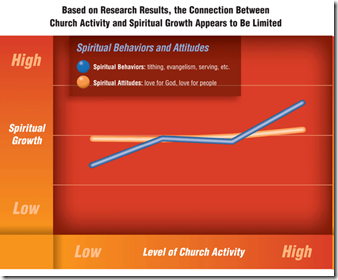
One of the five "key findings" of REVEAL is that there is not necessarily a correlation between commitment and church attendance, or community. This is what REVEAL reports:

We found that those who were the most active in the church did not necessarily report higher levels of spiritual attitudes (“love for God and others”) and spiritual behaviors (evangelism, tithing, etc.) than those who were less active.
This led us to discovering a Spiritual Continuum centered on a relationship with Jesus Christ, which was much more predictive of spiritual growth (Chart 3).

image

What I find interesting is that I missed the conversation going on in other quarters. I have a book I purchased a few years ago, long before REVEAL hit the stands, written by Joseph R. Myers, The Search to Belong.

In a chapter entitled "the myths of belonging (p9)," Myer writes:

More commitment = more belonging. People often believe that there is a significant relationship between commitment and community. That is, however, a romantic view. When we search to belong, we aren't really looking for commitment. We simply want to connect (p12).

I'm not saying that Willow Creek borrowed the idea, quite the contrary. When an organization as large as Willow Creek picks up on an issue that has been surfacing throughout the church,to say we are sensing a moving of the Spirit is a bit of an understatement.

This sentiment is also found in Rick Richardson's writings, such as Evangelism Outside the Box, as well as in the the halls of the emerging church.

So, what's next? That is the question that faces my colleagues and I in France. I'll get back to you.