Showing posts with label Crossroads. Show all posts

30 June 2010

Worship – A Dialogue on the Purposes of the Church: Who do we Worship?

worship

Sing to the Lord, all the earth. Psalm 96:1b

This post is a part of an ongoing dialogue about the five purposes of the church. The first post addressed the question of Who Do We Worship?  I want to continue to interact and dialog with Marva Dawn as she dialogs about the “Who” of worship in her book How Shall We Worship?

There is an interesting observation in her book (p. 20) about the nature of our cultures today, described by social analyst Christopher Lasch as a Culture of Narcissism.

Lasch stated that social developments in the 20th century, such as the end of World War II and the rise of a consumer culture in the years that followed, gave rise to a narcissistic personality structure in which peoples’ self-concepts led to a fear of commitment and lasting relationships (including religion), a fear of aging (e.g., the 1960s and 1970s "youth culture") and a overdeveloped admiration for fame and celebrity, nurtured in part by the motion picture industry and television. The result is confusion, anxiety and uncertainty about how to live and relate in the world today (see a review of Lasch here).

Marva believes that this culture of narcissism has entered the church, which has resulted in attitudes and views that ask the question, What’s in it for me? (p. 21) Ever have anyone say to you, “I didn’t get much out of the

worship service today.”

Since worship is the response of all creation to “God’s gift of being,” any response that we have that is “hunting for what will please ourselves” can be nothing more than sin.

A couple of the results that we see in churches today is the tendency to see Sunday morning worship as an evangelistic rally, i.e., using the appeal factor of the worship service to attract those who are not yet Christ-followers by appealing to their immersion in our narcissistic culture. Thus a church can entertain and give people the impression that they have been part of a worship experience.

But if worship is for God, can those outside the community of faith enter into worship? Or more bluntly, can we say that these kind of services qualify as worship?

A pastor friend made a comment to my previous post, “One of the things we teach about worship is that it includes every aspect of life, not just what we do together on a Sunday morning. Worship is also our service to God as we serve His people.”

That to me is the paradox of the question of worship: Worship is about God, but yet as we worship, we can also serve the people of God.  The example I have in mind is the Milepost 13 Band that recently came to Grenoble. I saw some aspects of worship that I hadn’t notice before. They are a worship band, so their main purpose or goal was to worship God. But yet they were also evangelistic in their concerts, and one of the biggest benefits was how they served the two congregations in Grenoble –one French speaking and one English speaking, and the fellowship and community we enjoyed as a result.

So for me, this is a marvelous picture of what worship can be, it is more than an subjective experience on Sunday morning. As Marva points out, worship is the glad response to the immense grace of Triune God.” So when God’s grace is pouring out on us, we can experience the outworking of that grace through fellowship, evangelism, service, et. al., which in turn should rebound in our response to that grace.

Yes, grace is amazing!


theologien

22 June 2008

The Myth of Belonging

sheep-belonging-to-tenant I'm a fan of REVEAL, the initiative started by Willow Creek. I think their findings concerning the reality of spiritual growth in the church are significant, and point to an issue that I have been harping preaching about for years.

The sources of the problem are largely the result of the descent of managerialism on the church. However, that is an issue for another post.

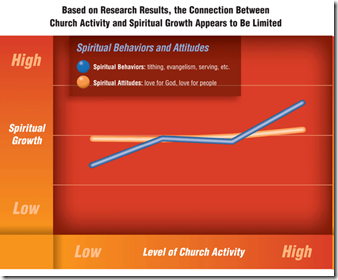
One of the five "key findings" of REVEAL is that there is not necessarily a correlation between commitment and church attendance, or community. This is what REVEAL reports:

We found that those who were the most active in the church did not necessarily report higher levels of spiritual attitudes (“love for God and others”) and spiritual behaviors (evangelism, tithing, etc.) than those who were less active.
This led us to discovering a Spiritual Continuum centered on a relationship with Jesus Christ, which was much more predictive of spiritual growth (Chart 3).

image

What I find interesting is that I missed the conversation going on in other quarters. I have a book I purchased a few years ago, long before REVEAL hit the stands, written by Joseph R. Myers, The Search to Belong.

In a chapter entitled "the myths of belonging (p9)," Myer writes:

More commitment = more belonging. People often believe that there is a significant relationship between commitment and community. That is, however, a romantic view. When we search to belong, we aren't really looking for commitment. We simply want to connect (p12).

I'm not saying that Willow Creek borrowed the idea, quite the contrary. When an organization as large as Willow Creek picks up on an issue that has been surfacing throughout the church,to say we are sensing a moving of the Spirit is a bit of an understatement.

This sentiment is also found in Rick Richardson's writings, such as Evangelism Outside the Box, as well as in the the halls of the emerging church.

So, what's next? That is the question that faces my colleagues and I in France. I'll get back to you.

27 December 2007

Is God more successful if there are other gods?

bunch_of_santas

It may be that the very thing that we attempt so hard to achieve may be the one thing that causes religion (Christianity) to go stale.

Evangelicals in the United States believe that society is losing its moral moorings, that the family is under attack, and that the traditional consensus on (read American) religious values is being lost or at the least sublimated by competing forces (e.g., pluralism, secularism) in culture. The spiritual environment in Europe is often painted as the next step for the United States in the journey away from faith in God and the loss of religious values in society.

Most of this picture is now being called into question by practitioners of sociology of religion. The traditional view is, sociologists of religion say, that the relationship between religion and American society resulted in a postwar America as settled in a period of industrialism. The widespread assumption was that the social order was underpinned by religious values, which not only preserved the status quo, but promoted the well-being of all.

This view of religion and America was derived from the normative functionalism of Talcott Parsons, who stressed above everything the integrative role of religion. His view was that religion was a functional prerequisite central to the models of social systems and social action that Parson's elaborated. American society was shaped by the focus on what people believed in the various churches, and that religion's role was in the integration of society and in promoting or discouraging social change.

However, sociologists such as Rodney Stark, Roger Finke and others are discovering a different picture.

“The natural state of a religious economy is pluralism,” Stark said. “Typically, pluralism has been repressed in favor of religious monopolies.”

For example, Stark contends in his book Cities of God that contrary to popular belief, Christianity flourished in cities in the Roman Empire that had a sizable plurality of religions. The rural setting proved to be resistant to the new religion long after the urban areas of the empire had become predominantly Christian.

Stark maintains that the same is true of the United States. The colonial era was a time of low religious fervor. This did not change until the colonies became more tolerant of religious traditions. Eventually the U.S. Constitution opened up the religious marketplace, making it easier for new religious groups to flourish. This religious freedom impacted the rising fortunes of such groups as Baptists, Methodists, and Catholics, but also saw the rise of such religions as Mormonism and Jehovah's witnesses. It was also the time when evangelism and the missions movement grew in importance.

The reason for this, says Stark and others, is that the religious mind is rational, and religion is the behavior of rational, well-informed actors who choose to 'consume' various commodities. Thus the choice of religious affiliation is made in a rational way, with the potential member weighing costs and benefits of each possible choice before choosing the one that maximizes rewards, although not necessarily that it minimizes costs. This model is referred to as an religious economies view (see Stark's The Rise of Christianity, p193-195).

A religious economy consists of all the religious activity going on in any society, and consists of a market of current and potential customers, a set of religious firms seeking to serve that market, as well as a line of products to serve those customers.

An open religious economy is a religious pluralism that forces each religious body to appeal successfully to some segment of the religious market, or to slide into oblivion. When various religious bodies specialize, it becomes easier for religious "consumers" to find the best product for them.

In other words, it seems that God likes competition. He has never necessarily been the guarantor of the status quo; after all he is especially concerned about the welfare of the widow, orphan, and alien in the land.

A another point that Stark and others make is about the modern view of secularization. The traditional view is that modernity was caused a decline in religious behavior and belief, caused by an increased emphasis on science and rationality that leads people away from supernatural explanations. Proponents of this view point to the low rates of religious adherence in northern Europe as evidence of the process of secularization.

However, Stark and other proponents of the religious economies perspective disagree. They believe that the religious condition of northern Europe is largely a supply-side problem rather than a lack of demand. That is, lack of religious participation in much of Europe reflects highly regulated [religious] economies dominated by state supported churches, and that these are inefficient firms who do nothing to create demand.

To put it another way, the choice is either a state supported church that offers little to the people, or, a general lack of belief and apathy toward religion.

What does this mean to us? Basically, people here in Europe have no real alternatives or choices. Christianity gained ascendancy in the Roman world because it could offer answers and alternatives to the questions of life that people faced day to day. Zeus, Thor, and Isis couldn't help, but Yahweh could. It is almost a remake of the conflict between Ba'al and Yahweh on Mt. Carmel (1 Kings 18). God seems to like competition.

It would seem, then, that our task is not to make Christianity the ascendant religion or the guarantor of the status quo. Instead, we should proclaim to others that Christ offers some real alternatives to the life they live now, to the questions that they face, and the hope that they need.


18 December 2007

Following Christ as a Journey

I came across this video by Bill Lizor, who works with young adult ministries out of the general board of discipleship of the United Methodist Church, entitled Prodigal Son vs Joseph & Jacob Paradigms. The focus of the clip is how do we view our journey of faith as we follow Christ. The clip is 15 minutes long, but worth a view...


This is not the first time I've encountered this theme. The best picture of this metaphor of biblical discipleship is explicated very nicely in James W. McClendon, Jr.'s Ethics, volume 1 of his Systematic Theology. (See a nice narrative about McClendon here).

McClendon's goal is to find the "momentum that carries Scripture's story forward." He captures this in three motifs: The Way, Watch-care, and Witness.

The Way focuses on the idea that the earliest motif found in Scripture is the idea of a band of travelers, e.g., "My father was a homeless Aramaean who went down to Egypt..." (Deut. 26:5). This carries through Scripture with the idea that the people of God are refugees and wanderers, looking for their home.

The journey continues in the New Testament. The incarnation of Jesus in the gospels understands Jesus as the way, the truth, and the life. Seen in this light, God's command becomes highway directions for life, and the journey of Jesus to the cross is one that every disciple must follow.

McClendon ties in the remaining two motifs of Watchcare and Witness by saying that:

Watch-care is the awareness of fellow travelers on this way who need our watchful care over their own journey,...
and...
The divine gift of Witness is to those who are not (yet) on the Way.
That is why the clip above resonates with me.

We've too often seen the journey of faith from the aspect of the Prodigal Son, with the focus on the younger son as someone outside (the other) the church, marginalized, without God. What McClendon posits, and Lizor points out, our story (or journey) is marked continually by the presence of God in our midst. The stories of Jacob and Joseph show this very clearly; the story of the Prodigal Son does not.

I think we need to rethink our approach to the Christian life. For example, how would this approach affect our evangelism? Our approach to spiritual formation?

04 June 2007

Are you listening?

I find it interesting when things seem to flow together. For example. I have had some long conversations with a friend about our church, and what it should look like. One of the things that my friend said is that our church is a crossroads.

A crossroads is a place where two or more roads meet. It is also a place where people tend to congregate at they travel these roads.


The Roman empire was noted for their roads, which facilitated travel across the length and breadth of the known world. Paul knew these roads and traveled them during his journeys, eventually ending in the city of Rome.

What was unique about Paul, and Christ as well, was that they knew the importance of a crossroads. Galilee was such a crossroads, and his teaching and preaching focused on the crossroads between Greek and Hebrew culture.

Paul focused on the major cities of Asia Minor and Greece, planting churches that would impact the people that passed through them with the claims of the gospel. These churches were planted in cities that were crossroads.

What my friend suggested was that Grenoble is a crossroads. People come here literally from all over the world, stay a while, and then move on elsewhere. We have people from the UK, France, US, Canada, Nigeria, Ghana, Kenya, China, Germany, Singapore, India --which is just a partial role call. If that is the case (and it is), what are we as a church doing to impact these people? How do we help them to begin a journey of faith with Christ, or to equip these saints for ministry, so that when they leave, they will be prepared to minister to others at their next stop?

This past weekend, Harry, the speaker at the men's dinner, spoke about hearing what is really said. As the story goes, he was driving in the country when a woman drove by and yelled "Pig!" at him. He leaned out the window and yelled "Cow!" He then came around a bend in the road and had to stop quickly, in the road in front of him was the largest pig he had ever seen.

I didn't think much about it at the time. Nor did I think much about the email I received from another friend discussing the vertical and horizontal axes of the cross. The upward axis is the Christian life lived to and for God, and the horizontal axis is the Christian life lived to and for other Christians and others who have yet to follow Christ in the faith journey.

I've heard it before, so basically I filed it away. During the sermon on Sunday about the church in Acts 2v42-47, the main illustration was a picture of a cross, with a discussion about the significance of the horizontal and vertical axes, as mentioned above.

I was beginning to hear. I knew that the church should be a crossroads, but I hadn't considered what that looked like. We had to be a crossroads, but to do that we had to have both the horizontal and the vertical axes in place and in balance. And, quite frankly, seen from above, the crossroads is cross shaped.

So Harry, I think I got what you meant. You need to listen to what is said, but often what is said is in a conversation, which means it often comes in little pieces. It also means that sometimes you don't get it right off, it had to soak for a while before you can do anything with it.