Showing posts with label Leadership. Show all posts

08 September 2009

15 Theses by Wolgang Simson (Conclusion)

01_Hours_a15. The Church comes home

Where is the easiest place, say, for a man to be spiritual? Maybe again, is it hiding behind a big pulpit, dressed up in holy robes, preaching holy words to a faceless crowd and then disappearing into an office? And what is the most difficult, and therefore most meaningful, place for a man to be spiritual? At home, in the presence of his wife and children, where everything he does and says is automatically put through a spiritual litmus test against reality, where hypocrisy can be effectively weeded out and authenticity can grow. Much of Christianity has fled the family, often as a place of its own spiritual defeat, and then has organized artificial performances in sacred buildings far from the atmosphere of real life. As God is in the business of recapturing the homes, the church turns back to its roots, back to where it came from. It literally comes home, completing the circle of Church history at the end of world history.

As Christians of all walks of life, from all denominations and backgrounds, feel a clear echo in their spirit to what God's Spirit is saying to the Church, and start to hear globally in order to act locally, they begin to function again as one body. They organize themselves into neighborhood house-churches and meet in regional or city-celebrations. You are invited to become part of this movement and make your own contribution. Maybe your home, too, will become a house that changes the world.

You are welcome and encouraged to redistribute this article.

Technorati Tags:

06 September 2009

15 These by Wolfgang Simson (Part 7)

Lords-Supper 11. Stop bringing people to church, and start bringing the church to the people

The church is changing back from being a Come-structure to being again a Go-structure. As one result, the Church needs to stop trying to bring people "into the church," and start bringing the Church to the people. The mission of the Church will never be accomplished just by adding to the existing structure; it will take nothing less than a mushrooming of the church through spontaneous multiplication of itself into areas of the population of the world, where Christ is not yet known.

12. Rediscovering the "Lord's Supper" to be a real supper with real food

Church tradition has managed to "celebrate the Lord's Supper" in a homeopathic and deeply religious form, characteristically with a few drops of wine, a tasteless cookie and a sad face. However, the "Lord's Supper" was actually more a substantial supper with a symbolic meaning, than a symbolic supper with a substantial meaning. God is restoring eating back into our meeting.

Technorati Tags:

04 September 2009

15 Theses by Wolfgang Simson (Part 6)

worship 9. Return from organized to organic forms of Christianity

The "Body of Christ" is a vivid description of an organic, not an organized, being. Church consists on its local level of a multitude of spiritual families, which are organically related to each other as a network, where the way the pieces are functioning together is an integral part of the message of the whole. What has become a maximum of organization with a minimum of organism, has to be changed into a minimum of organization to allow a maximum of organism. Too much organization has, like a straightjacket, often choked the organism for fear that something might go wrong. Fear is the opposite of faith, and not exactly a Christian virtue. Fear wants to control, faith can trust. Control, therefore, may be good, but trust is better. The Body of Christ is entrusted by God into the hands of steward-minded people with a supernatural charismatic gift to believe God that He is still in control, even if they are not. A development of trust-related regional and national networks, not a new arrangement of political ecumenism is necessary for organic forms of Christianity to reemerge.

10. From worshipping our worship to worshipping God

The image of much of contemporary Christianity can be summarized, a bit euphemistically, as holy people coming regularly to a holy place at a holy day at a holy hour to participate in a holy ritual lead by a holy man dressed in holy clothes against a holy fee. Since this regular performance-oriented enterprise called "worship service" requires a lot of organizational talent and administrative bureaucracy to keep going, formalized and institutionalized patterns developed quickly into rigid traditions. Statistically, a traditional 1-2 hour "worship service" is very resource-hungry but actually produces very little fruit in terms of discipling people, that is, in changed lives. Economically speaking, it might be a "high input and low output" structure. Traditionally, the desire to "worship in the right way" has led to much denominationalism, confessionalism and nominalism. This not only ignores that Christians are called to "worship in truth and in spirit," not in cathedrals holding songbooks, but also ignores that most of life is informal, and so is Christianity as "the Way of Life." Do we need to change from being powerful actors to start "acting powerfully?"

Technorati Tags:

03 September 2009

15 Theses by Wolfgang Simson (Part 5)

Puzzles 7. The right pieces - fitted together in the wrong way

In doing a puzzle, we need to have the right original for the pieces, otherwise the final product, the whole picture, turns out wrong, and the individual pieces do not make much sense. This has happened to large parts of the Christian world: we have all the right pieces, but have fitted them together wrong, because of fear, tradition, religious jealousy and a power-and-control mentality. As water is found in three forms, ice, water and steam, the five ministries mentioned in Eph. 4:11-12, the Apostles, Prophets, Pastors, Teachers and Evangelists are also found today, but not always in the right forms and in the right places: they are often frozen to ice in the rigid system of institutionalized Christianity; they sometimes exist as clear water; or they have vanished like steam into the thin air of free-flying ministries and "independent" churches, accountable to no-one. As it is best to water flowers with the fluid version of water, these five equipping ministries will have to be transformed back into new, and at the same time age-old, forms, so that the whole spiritual organism can flourish and the individual "ministers" can find their proper role and place in the whole. That is one more reason why we need to return back to the Maker's original and blueprint for the Church.

8. God does not leave the Church in the hands of bureaucratic clergy

No expression of a New Testament church is ever led by just one professional "holy man" doing the business of communicating with God and then feeding some relatively passive religious consumers Moses-style. Christianity has adopted this method from pagan religions, or at best from the Old Testament. The heavy professionalization of the church since Constantine has now been a pervasive influence long enough, dividing the people of God artificially into laity and clergy. According to the New Testament (1 Tim. 2:5), "there is one God, and one mediator also between God and men, the man Christ Jesus." God simply does not bless religious professionals to force themselves in-between people and God forever. The veil is torn, and God is allowing people to access Himself directly through Jesus Christ, the only Way. To enable the priesthood of all believers, the present system will have to change completely. Bureaucracy is the most dubious of all administrative systems, because it basically asks only two questions: yes or no. There is no room for spontaneity and humanity, no room for real life. This may be OK for politics and companies, but not the Church. God seems to be in the business of delivering His Church from a Babylonian captivity of religious bureaucrats and controlling spirits into the public domain, the hands of ordinary people made extraordinary by God, who, like in the old days, may still smell of fish, perfume and revolution.

Technorati Tags:

02 September 2009

15 Theses by Wolfgang Simson (Part 4)

sml-church 5. The church has to become small in order to grow big

Most churches of today are simply too big to provide real fellowship. They have too often become "fellowships without fellowship." The New Testament Church was a mass of small groups, typically between 10 and 15 people. It grew not upward into big congregations between 20 and 300 people filling a cathedral and making real, mutual communication improbable. Instead, it multiplied "sidewards", like organic cells, once these groups reached around 15-20 people. Then, if possible, it drew all the Christians together into citywide celebrations, as with Solomon's Temple court in Jerusalem. The traditional congregational church as we know it is, statistically speaking, neither big nor beautiful, but rather a sad compromise, an overgrown house-church and an under-grown celebration, often missing the dynamics of both.

6. No church is led by a Pastor alone

The local church is not led by a Pastor, but fathered by an Elder, a local person of wisdom and reality. The local house-churches are then networked into a movement by the combination of elders and members of the so-called five-fold ministries (Apostles, Prophets, Pastors, Evangelists and Teachers) circulating "from house to house," whereby there is a special foundational role to play for the apostolic and prophetic ministries (Eph. 2:20, and 4:11.12). A Pastor (shepherd) is a very necessary part of the whole team, but he cannot fulfill more than a part of the whole task of "equipping the saints for the ministry," and has to be complemented synergistically by the other four ministries in order to function properly.

Technorati Tags:

01 September 2009

A philosophy of education and experience?

JDewey.jpg (337×449)

John Dewey proposed a philosophy of education that focused on traditional education (education from without) and progressive education (experience, education from within). Traditional education focuses mainly on content, but it can become a “banking concept” for the transfer of knowledge.

Progressive education (education from within, or experience) is the other school of thought. Basically, it is grows out of our life experiences; but without sufficient or proper content, it will do little to offer growth or development. For Dewey, there needed to be a proper tension between education and experience.

As an educator in the church, I think we need the tension between what we are taught and what we experience in our spiritual formation. Teaching that is little more than throwing words out to the learner and hope that somehow they will appropriate them and figure out what we need to know and put into practice is not much use, either to the learner or to the body of Christ . 

Our preaching and teaching needs to educate us (think of it, if you will, as providing the raw materials), it should also provide guided, practical experiences that will help us to understand and assimilate what we have learned and how to apply it to life in order to promote growth and development in our spiritual formation.

Next time: What are we to teach?

31 August 2009

15 Theses by Wolfgang Simson (Part 1)

House Church Central has an article by Wolfgang Simson with 15 theses on the church. At some point later I want to do a series of posts on each of his points. What are your thoughts? 

1. Church is a Way of Life, not a series of religious meetings

Before they where called Christians, followers of Christ have been called "The Way". One of the reasons was, that they have literally found "the way to live." The nature of Church is not reflected in a constant series of religious meetings lead by professional clergy in holy rooms specially reserved to experience Jesus, but in the prophetic way followers of Christ live their everyday life in spiritually extended families as a vivid answer to the questions society faces, at the place where it counts most: in their homes.

Technorati Tags:

09 April 2009

Missional Activity (according to Larry Crabb)

pegs-1I want to share a few thoughts that Larry Crabb presented at the School of Spiritual Direction this past week.

It deals with the idea of what it means to be missional. Yes, of course, I’ve been a fan of the emerging church and what it means to be missional, but there always seems to be something missing.

I think Scot McKnight’s comment about postmodernism and its relationship to the emerging church in the April 2009 issue of the UK Magazine Christianity,

We found that it tasted good, even if at times we found ourselves spitting out hard chunks of nonsense.

I can concur with that sentiment. However, Larry Crabb gave a short overview of what he thinks it means to be missional, which I would like to reproduce here.

Disclaimer: Any cloudiness or murkiness engendered by this article is my fault and not Larry Crabb’s.

Larry suggested that often we approach the missional activity like this:

Idea:

This is based on our Passion, message, vision, and Strategy.

What do we do? We dialogue, organize, and initiate. And we end up with:

  • Package the message
  • Get a plan
  • Create a team
  • Pray

The result? We make it happen!

This is linear, systems thinking at its best.

Larry Crabb suggests another path: Reflect, repent, and release.

Again we start with an Idea:

1. We begin by reflecting as asking the questions: What is my ruling passion? What is God’s passion? What other passions do we see?

2. We look at Relationships. The questions we ask may include:

  • What is my lifestyle?
  • Am I weary or tired?
  • Can I say “no”?
  • Am I appreciative of others?
  • What kind of feedback am I getting?
  • What is my history?
  • Do I have self awareness of this idea?

3. This leads to Repentance.

  • Where’s the fire?
  • Is there a spirit of rest?
  • Do I have the courage to say no?
  • Is it attractive to others (especially to those closest to me)?

4. This leads to a Release to Ministry. This leads to:

  • Prayer
  • Discerning a commitment
  • What has God provided
  • The message is developed
  • There is a deliberate strategy

This is definitely not systems thinking. It is also not how we usually do ministry. Think about it, and work through it, and give me any feedback you may have.

theologien


10 November 2008

Barack and the Bible

How did we miss this? 

Then Deborah said to Barak, “Get ready! This is the day the Lord will give you victory… for the Lord is marching ahead of you.” So Barak led his warriors down the slopes… into battle.
Judges 4:14


Posted using ShareThis

25 October 2008

A Hedge or a Sword?

Hedgerows are a part of the history of humankind. They have been around since the Bronze Age, although many of the older hedgerows found today in Europe were first planted during Roman times.

They made life a living hell for soldiers of the Allied armies trying to break out of the Normandy beachhead in WW2. The hedgerows that they encountered, called bocage by the French, consisted of small, irregularly shaped fields, measuring only about 200 by 400 meters, enclosed by ancient, overgrown hedges that grow from earthen mounds flanked by drainage ditches.

These hedgerows surrounding the fields were four to ten feet thick, grew up to 15 feet high, limiting visibility to one field at a time, and were impenetrably dense — even for tanks. They formed a thousand square miles of tough patchwork terrain, connected by a network of dirt roads sunken far below field level.

The idea of a hedge is found in the writings of the Rabbis. They surrounded the law with a hedge, a body of interpretations, expansions, and applications of the Law that they came to regard as of divine origin. Look at this example from the Mishnah:
Moses received the Torah from Sinai and transmitted it to Joshua; Joshua to the elders; the elders to the prophets; and the prophets handed it down to the men of the Great Assembly. They said three things: Be deliberate in judgment, raise up many disciples, and make a fence around the Torah (Pirke Aboth, 1:1).
Incidentally, the word translated fence is a mishnaic hebrew word (סיג) for wall, fence, or a thick hedge.

Since you could inadvertently break the Law, we find the principle of “putting a hedge around the Law,” not to protect it, but to provide a margin of safety. Whatever one thought right to do, the oral Torah provided a margin of error. Any commandment was an opportunity to show one’s obedience. For Jesus this kind of scrupulous observance would only lead to a neglect of the major points of the Law. It is inevitable that there was an over-concentration on the manageable, the visual and perceptible things of the law—to the neglect of the weightier matters:
‘Woe to you, teachers of the law and Pharisees, you hypocrites! You give a tenth of your spices—mint, dill and cumin. But you have neglected the more important matters of the law—justice, mercy and faithfulness. You should have practised the latter, without neglecting the former. You blind guides! You strain out a gnat but swallow a camel (Matt. 23:23-24).
Speaking to the city of Jerusalem through the Prophet Isaiah, God likens the city of Jerusalem to the planting of a vineyard:
Let me sing for my beloved
my love-song concerning his vineyard:
My beloved had a vineyard
on a very fertile hill.
He dug it and cleared it of stones,
and planted it with choice vines;
he built a watchtower in the midst of it,
and hewed out a wine vat in it;
he expected it to yield grapes,… (Isaiah 5:1-2)
The problem? quite simply:
...but it yielded wild grapes (Isaiah 5:2b)
The wild grapes, according the metaphor, are the sins and unrighteous acts of the people:
For the vineyard of the Lord of hosts
is the house of Israel,
and the people of Judah
are his pleasant planting;
he expected justice,
but saw bloodshed;
righteousness,
but heard a cry! (Isaiah 5:7)
Because they refused to turn away from the sins and crimes, God made a promise:
And now I will tell you
what I will do to my vineyard.
I will remove its hedge,
and it shall be devoured;
I will break down its wall,
and it shall be trampled down. (Isaiah5:5)
Hedges are meant for protection, either on a literal or metaphorical level. But I notice that a sense of complacency often occurs among those living inside a building, vineyard, or city protected by a hedge. God uses the hedge as a metaphor for his protection, by breaking down the hedge he allows the enemy to pour in to execute judgment.

What struck me is that I, like many people, often pray for a hedge of protection for myself and others. I’m not so sure that is the best use of that metaphor. I would agree that there are times when we need protection, but that is a passive approach to living the Christian life. I think Paul has a better approach:
10 Finally, be strong in the Lord and in his mighty power. 11 Put on the full armor of God, so that you can take your stand against the devil’s schemes. 12 For our struggle is not against flesh and blood, but against the rulers, against the authorities, against the powers of this dark world and against the spiritual forces of evil in the heavenly realms. 13 Therefore put on the full armour of God, so that when the day of evil comes, you may be able to stand your ground, and after you have done everything, to stand. 14 Stand firm then, with the belt of truth buckled round your waist, with the breastplate of righteousness in place, 15 and with your feet fitted with the readiness that comes from the gospel of peace.
16 In addition to all this, take up the shield of faith, with which you can extinguish all the flaming arrows of the evil one. 17 Take the helmet of salvation and the sword of the Spirit, which is the word of God. 18 And pray in the Spirit on all occasions with all kinds of prayers and requests. With this in mind, be alert and always keep on praying for all the Lord’s people (Ephesians 6:10-18).
Sort of reminds me of Nehemiah’s instructions to carry a sword in on hand and trowel in the other (Nehemiah 4:16-18).

So, the question is, do live behind a hedge, or do we follow Christ, in full panoply, ready for the day?

07 August 2008

More on "Missions? Missional?"

BastilleDauFirworks2008 In a previous post I shared a discussion I had with someone about the idea of missions in the church.

I want to take another look at one of these points: 
4. The French, the .... (fill in the blank) had their chance.
The premise is that France, Europe, etc., has had a chance to hear the gospel but rejected it, so now we want to go where they will be open to the gospel.

My question is, where would that be?  Europe has rejected the gospel, yes, but it is responding to it, though slowly. As my wife has also pointed out, when exactly did the French reject the gospel?  In the eighth century? 17th century? During the French Revolution? Recently? Did everyone do it? Just a few? Did someone pass a law to that effect?

How about China, they've rejected the gospel, shall we cross them off our list? China is closed, but it was a major missions field until the communist takeover in 1949. The new government then expelled all Christian missionaries from their borders. Yet Christianity is growing rapidly.

Perhaps Eastern Europe? It was closed to missionaries and the gospel for many years during the communist hegemony, but now it is once again open.

Or maybe the Middle East and North Africa? Everyone knows that people of Islamic background faith are resistant to the gospel, so perhaps we should not invest time and people to share the gospel with them?


If we shake the dust off our feet, and seek a place to go where people will be open to the gospel, I think that pretty much limits us to Antarctica.

And what of the United States? Is the gospel received in this country? I think it is obvious that the church is losing ground in the United States. Yet we are willing to plant new churches. According to the premise stated above, this seems counter-intuitive.

I find these facts interesting:

“Fifty-nine percent of U.S. congregations have fewer than one hundred regular participants, counting both adults and children; 71 percent have fewer than one hundred regularly participating adults”
"10 percent of U.S. congregations—the largest ones—contain half of the nation’s churchgoers."
So, if we are consistent in following our original premise, why start a church plant when this country is rejecting the gospel? Aren't there enough churches now that we have to start a new one?

I think this points to the fact that the church in the US has a less than adequate understanding of what it means to be missional, or to be in missions. And when the church is at odds to the world and can only expect enmity, what makes us think we can find anywhere that the gospel will be welcomed?

30 June 2008

Missions? Missional? (revised 14 July)

missions2 I recently had a discussion with a friend about missions in the church.  Granted, he was talking about a specific church, but his comments reflect a common thought process and approach to missions in the emerging church. 

My friend told me that there were several parameters for the missions focus of the church, such as:

1. The mission field had to be accessible.

services5 For my friend, that means that anyone who wants to go to a specific field can access it without a long flight or paying a lot of money for a ticket. Wouldn't that eliminate most of Europe, the Middle East, and much of Asia? Is accessibility to the field a major specification for missions?

When the Holy Spirit said to separate out Paul and Barnabas for a mission, was it based on accessibility of the mission field to Paul and others? Did the HS only send them to places where they found it easy to go?  Mission history abounds in stories of people such as Hudson Taylor, Adoniram Judson, David Brainerd and others who gave up family, friends, and secure lives to go to proclaim the gospel, at great personal cost to them. Judson, for example, spent months traveling to Burma, a country closed to the west, only to be thrown into prison by a government that was suspicious to him and reasons for being in Burma.

As for Paul, there were times when he wanted to go somewhere, and the HS did not allow him to go at first (Acts 16:6-10), in addition, the times Paul suffered for the sake of the gospel (2 Corinthians 11:23-33) would seem to have an impact on the accessibility of the field.

For whom is the mission field to be accessible? Everyone in the church? A few chosen individuals?

I don't believe that accessibility be a primary specification for mission.

2. Biggest bang for the buck?

biggest-bang-buck I will be the first to say that we are to use good stewardship, but does that dictate the shape of missions, and where we are to go?

Again, cost was not the dictating factor for Paul and Barnabas. The Holy Spirit sends and provides the means to do so.  It is not that we should obsess over the money, but how we follow the leading of the Spirit. I don't think we do this by setting up parameters and hurdles to force the Spirit to do and work as we want, based on budget considerations.


3. Is it Mission Field or Missionary?
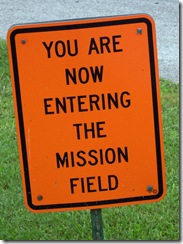
Mission Field Cropped When the Holy Spirit was preparing for the outward expansion of the church, he spoke through the prophets in Antioch saying, "Separate Paul and Barnabas for the work to which I have called them (Acts 13)."

As for Jesus, he told his followers, “As the Father has sent me, I am sending you” (John 20:21). When we look at the the various forms of the great commission, the focus for mission is obedience, The specific area mentioned is the world, not one geographical location.

The Spirit did not ask the church in Antioch to separate out a mission field, but a missionary.  Is our emphasis on a field backwards? Or do we send people out to the field whom God has called?  I think so.


4. The French, the .... (fill in the blank) had their chance.

French-food The idea is that a specific area has been evangelized and had the gospel, but they rejected it, so we will go someplace where they will accept the gospel.  I have had this said to me about France, and Europe in general.  Yet is the place where the stirrings of the Spirit are evident.

First, who gives anyone the right to pass judgment by saying they had their chance, now it's too late? I was under the impression that God does not want anyone to be lost, but to have the fullness of life, and have it abundantly?

And where will you go? Somewhere (like Nigeria, for example...??) where they will receive the gospel? Nigeria is over 55% Christian (by their profession), but it is also a very materialistic church that is submerged in the culture and compromised by it, not unlike the United States.

There are other places to go, China is a large potential area for the gospel, but there are issues of accessibility for these areas. China, Burma, Vietnam, and other areas are closed to missionaries.

5. Go Make Disciples

holyspirit I have been told that the mission of the church needs to start where the church is located (i.e., Jerusalem), and then move to Judea and Samaria (outside your community), and finally into Europe, Asia, Africa, or where ever.

The problem is that the various passages tagged as part of the Great Commission are often seen as a linear process, i.e., start where you are, then go out from there.  Unfortunately, the result of this is that this is taken to mean that we need to plant ourselves and be fruitful and successful at one level before we progress to the next.  So, we need to fully evangelize, preach, teach, feed, clothe, etc. in one place before we move to the next.

I doubt we can build a case for this either theologically or linguistically. The Greek text behind Acts 1:8 does not support a progressive or "step by step" plan for evangelism.  There are several good ways of understanding the conjunction καὶ (usually translated as "and"), but the best way to understand the use of καὶ in this passage is as a coordinating conjunction with an ascensive function, a point of focus, as Wallace comments (Greek Grammar Beyond the Basics, p 761).  The focus of the passage is the whole world, as Matthew 28:19 points out.

Theologically, Matthew 28 states that we are to make disciples of all nations. The command is holistic, not fragmented into parts or agendas.  That is modern management practice.

Another story that illustrates this very nicely is the persecution in Acts 8. The church was busy hunkering down in Jerusalem when a persecution breaks out and pushes them out of Jerusalem into Judea and Samaria, and by implication, Antioch in Syria. It was the intent of the Holy Spirit that they move out into the world. Left to their own devices, the church would probably only be reaching Greece today.

I am also impressed by the fact that Jesus chose to go throughout all the villages and towns of Galilee, not picking out one town and set up a ministry there. Paul was sent out by the Spirit, first to Asia Minor, then to Greece and finally to Rome.  Did he evangelize all the areas in between, therefore he needed to move on to the next mission field?

So, I don't think we can build a case that we have to set down a base in one place, overwhelm it with the gospel, then move on to the next area.  

So, being sent, being missional, or whatever we choose to call it, is not what we often make of it.

Final Notes:
Please don't think that I am against serving the poor, oppressed, marginalized, or social justice.  Anyone who knows me will testify to my vision of the rule of the Kingdom in our lives. I believe in righteousness and justice. Righteousness in the individual axis of our relationship with God, and justice is the community or social aspect of our relationship with God.

I don't know quite how to verbalize the disconnect I mentioned above, but I think the issue of the focus of missions/missional breaks down into call and vocation (what we do?), which focuses on making disciples of all nations, and life in the kingdom (what we are?).
The intersection of these two trajectories are summarized in this petition from the Lord's prayer, which says:
10 your kingdom come, your will be done, on earth as it is in heaven.  (Matt. 6:10)
I think that drives our desire to reach out to the poor and marginalized is because we want to do something significant, to make a difference. My response to this can be best illustrated by something I heard Jim Plueddemann once say, which goes something like this:

We can do something SIGNIFICANT! for God, or
we can do something significant for GOD!
Significance comes in obedience to God, as we seek to serve him. But the answer to how is yes.
Finally, to run missions through a grid like this pretty much pre-defines what the will of God would look like.  It take the worry of faith as well, because you see by sight...


02 May 2008

Some Good Advice

Okay, I admit this is not one of my strengths, which probably why I find it an interesting clip. It's worth a look at any case.

13 January 2008

Creating Customer Evangelists: Another Take

creating_customer_evangelists Here is another take on my previous post. This take on creating customer evangelists is from a marketing web site that can be found here. I think the examples and explanations are better than the web site of the authors.

According to McConnell and Huba, who co-authored the book "Creating Customer Evangelists," the number one indicator of growth is whether a customer would recommend a brand to a friend or colleague. They demonstrate that the best sources of information for customers interested in new products and services is word of mouth.

Customers who make recommendations for such things to their circle of friends and colleagues are considered evangelists -- customers with a true loyalty to a brand.

The authors define loyalty as the willingness of someone -- a customer, an employee, a friend -- to make an investment or personal sacrifice in order to strengthen a relationship.

An evangelist will often take responsibility for the brand's continued success. They will support you, defend you, help you improve your products and services, recruit new customers for you, and spread the word.

So, how does one gain evangelists? The authors list six steps:

1. Customer plus-delta. The point here is to continually gather feedback. One way the authors suggest to do this is by creating a customer advisory board. One business, for example, created such a board, asking select customers to find areas where improvement was needed. Their comments and suggestions resulted in a 30 percent increase in revenue for the company.

McConnell and Huba suggest you make it a voluntary system, but provide the board members with access to leaders and principles, and keep them in the know with what's happening at the company.

2. Napsterize your knowledge -- Make it a point to share knowledge freely -- even if you think it's secret or proprietary. "The value of an idea increases in value as it reaches more people," said McConnell.

Another way to share knowledge is through a blog.

3. Build the buzz. Evangelism is a long-term strategy -- buzz is the fodder that keeps the evangelists talking. To stimulate buzz, the authors suggest disclosing information to those widely connected, go beyond the obvious, make your "behind the scenes' visible and be a little outrageous.

Of course this requires identifying your network and the hubs that supply the most connections.

4. Create community. Don't think of customers as transactions. Think of them as a community of like-minded people. Then, address the community, not the transaction.

Tactics can include creating calendars of events in which your community would be interested.

5. Make bite-size chunks. Do you have a service that is complex? Devise specialized, smaller offerings to get customers to bite. For example, consultants can create workbooks or seminars to provide a piece of what they have to offer.

6. Create a cause. Think about what your organization stands for. How are you trying to change the world?

Every organization can have a cause in which it's passionate.

Among the benefits of a well-defined cause:

  • It embodies a vision
  • It makes people better
  • It generates big effects
  • It catalyzes selfless actions
  • It polarizes effects.

Of course, we are talking about the church, and not a business, but if you read between the lines, I see a few places where these suggestions can help the church accomplish its mission to reach people. Actually, much of this is stuff that the church should have been doing all along.

Let us look at a few examples. One of the purposes of the church is to create community. It is more than Sunday morning, and more than pot lucks.

Or, create a cause. What does the church stand for as the body of Christ. Are we not called to change the world, called to carry the crucified and resurrected Christ to a dying world?

The idea of gathering feedback and sharing knowledge is an area that is tough to work around in the church. If the church sees itself in the country club mentality, then it will offer people a professional wait-staff to take care of their needs. This also means that often the workings and information of the church remains a mystery meat. Most information is not privileged, but we guard it like a government secret.

17 November 2007

Systems and structure

Pope-leo My friend from Scotland and I have had an ongoing conversation about how to do church. The one thing that we've tried to do is to hear what God is saying about the mission and purpose of the church that we attend. This has been an ongoing conversation, and now we are widening the conversation to a few others to help us know if we are hearing right. I think we are.

But, our greatest frustration is getting others to focus on what the church should be about. We find that the more we focus on the mission and purpose statements of the church, the more resistance to change we encounter.

Last night we had a particularly "spirited" conversation about the topic, and I sensed that as we parted company, we were both a little frustrated and feeling down about our seeming lack of progress.

The conversation continued this morning, and one thought came out of all this. We have been focusing on changing the system, and not the people. The passage that came to mind was Eph. 6:12:

12 For our struggle is not against flesh and blood, but against the rulers, against the authorities, against the powers of this dark world and against the spiritual forces of evil in the heavenly realms.

What this tells me is that we are trying to change the system, and not the people in the system. In other words, we are fighting a losing battle. As long the system is our focus, we are lost in a quagmire that will only drain us and spit us out like a seed from a piece of fruit.

The result is that we have to change our focus to not simply addressing the problem by writing a vision/mission/purpose statement for the system, we need to make our main focus the need to disciple, mentor, do spiritual formation, make disciples, etc., in order for change to happen. This will happen because we need to make the role of the Holy Spirit in each person's life of paramount importance.

So, structure is good, it is necessary, but that isn't what we are called to do. We are called to introduce people --not the system, to Christ, so that we all may experience abundant life.

What this makes me wonder is, how many times in the past I've looked directly into the sun and not seen it?

09 November 2007

Structure and Design

Cathedral-1000Bob Robinson over at Vanguard Church has posted an interesting article on structure and design, part of his continuing exploration of Appreciative Inquiry. My response is that the process of AI often leads one back to issues of structure and design of the church.

It isn't always WHAT we are doing, but WHY we are doing it.

About the same time I also received the monthly newsletter from Gary Collins, which contained an article about decision paralysis. His focus as a coach is on working with people who have difficulty making decisions. Collins says that this issue is often one of the reasons why churches falter in their mission and ministry.

A lot of churches are good at giving you a lot of generic ministry. For example, sermons seem to be based on some nebulous, distant purpose or idea, but do not seem to have much to do with why the church is in town. There may be a lot of activity, but the attention span of the members of the church seems short lived, and the church has to reinvent itself in the Fall or Spring, and come up with another set of new programs

I find what Collins has to say interesting:

At times every coach works with people who have difficulty making decisions. This decision making process is hardest when a client, organization or business must choose between options that are equally attractive. ...as people face a variety of options they can become overloaded and tyrannized by “decision paralysis.”

We think we know what we need to do, but faced with the problem and possible alternatives, we slow to a crawl and either cannot make a decision or we develop a generic, one size fits all, type of ministry. It fails to have structure or design.

For Collins, if a church wants to have structure and design, then, one way to "...make tough decisions easier is to be guided by a clear, concise, easy-to-remember mission statement."

The mission statement helps us to make decisions about who to reach out to, what to teach, where to focus our energies, and what path is best for the church ministry.

As Collins says, "The best mission statements don’t just hang in a frame on the wall. They can be useful guides for making decisions and reducing decision paralysis."

Or to put it another way, how do you encourage people in a church to be all God wants them if you don't know what you want them to be? That's where a mission statement comes in to play.

The point of all this then is to say, AI can lead you to discover the various processes and strengths of a church, but if you don't know where you are going, one place is as good as another.

08 November 2007

Structure

Contributor36Another post in my ongoing struggle for clarity in understanding the function of the church.

Below I have listed some of the characteristics of the emerging church as seen through the eyes of Scot McKnight (see here and here for more).

1. Prophetic rhetoric. Christians believe the church needs to change, and they are beginning to live as if that change had already occurred.

2. Postmodernity cannot be reduced to the denial of truth. Instead, it is the collapse of inherited metanarratives (overarching explanations of life) like those of science or Marxism. Why have they collapsed? Because of the impossibility of getting outside their assumptions.

3. Praxis - what most characterizes the emerging church is the stream best called praxis—how the faith is lived out. At its core, the emerging movement is an attempt to fashion a new ecclesiology (doctrine of the church). Its distinctive emphases can be seen in its worship, its concern with orthopraxy, and its missional orientation.

Orthopraxy - is right living. The contention is that how a person lives is more important than what he or she believes.

Worship - Evangelicals sometimes forget that God cares about sacred space and ritual—he told Moses how to design the tabernacle and gave detailed directions to Solomon for building a majestic Temple.

Missional - by participating with God in the redemptive work of God in this world. In essence, it joins with the apostle Paul in saying that God has given us "the ministry of reconciliation" (2 Cor. 5:18).
Second, it seeks to become missional by participating in the community where God's redemptive work occurs. The church is the community through which God works and in which God manifests the credibility of the gospel.
Third, becoming missional means participating in the holistic redemptive work of God in this world. The Spirit groans, the creation groans, and we groan for the redemption of God (see Rom. 8:18-27).

4. Post-evangelical - The emerging movement is a protest against much of evangelicalism as currently practiced. It is post-evangelical in the way that neo-evangelicalism (in the 1950s) was post-fundamentalist. It would not be unfair to call it postmodern evangelicalism. This stream flows from the conviction that the church must always be reforming itself.

5. Political - A final stream flowing into the emerging lake is politics. Emerging churches are regularly told that the emerging movement is a latte-drinking, backpack-lugging, Birkenstock-wearing group of 21st-century, left-wing, hippie wannabes. Put directly, they are Democrats. And that spells "post" for conservative-evangelical-politics-as-usual.

One of the reasons for this post is that I downloaded Windows Live Writer, another Microsoft idea's on how to take over another aspect of the E-world. I was somewhat cynical about the program (as I am of almost anything Microsoft), but this program helped me write a blog and post it with out all the processes and aggravations that are found on Blogger. It does make the blogging process easier, so maybe something good can come out of Galilee after all.

Disclaimer: No bloggers were hurt in the writing of this blog.

21 July 2007

Swarm Theory

When we visited Grenoble a few years ago, my friend Matt told me about what he called the Hive Mentality, which states that the group or colony is smarter than the individual, and that the group will work together successfully without a leader. At the time, I thought that Matt was pretty smart and the subject very intense.

Well, three years later, I still think Matt is pretty smart, and I still think that the topic is still very intense. I came across an article online at the National Geographic website about Swarm Intelligence. Swarm intelligence is based on the study of collective behavior in decentralized, self-organized systems (e.g., insects, birds, and fish). Basically the thrust of the argument is this:

“Ants aren't smart," Gordon says. "Ant colonies are." A colony can solve problems unthinkable for individual ants, such as finding the shortest path to the best food source, allocating workers to different tasks, or defending a territory from neighbors. As individuals, ants might be tiny dummies, but as colonies they respond quickly and effectively to their environment. They do it with something called swarm intelligence.”

The incredible thing about swarm intelligence is that...

One key to an ant colony, for example, is that no one's in charge. No generals command ant warriors. No managers boss ant workers. The queen plays no role except to lay eggs. Even with half a million ants, a colony functions just fine with no management at all—at least none that we would recognize. It relies instead upon countless interactions between individual ants, each of which is following simple rules of thumb. Scientists describe such a system as self-organizing.

Another thing that fascinates me is how ants (or in this case, bees) arrived at decisions. In one test, they set out five boxes as potential hives for bees and watched as the scouting bees investigated the potential new nests. After bees had visited all the boxes, a decision had to be made which one would make the best nest.

The decisive moment didn't take place in the main cluster of bees, but out at the boxes, where scouts were building up. As soon as the number of scouts visible near the entrance to a box reached about 15—a threshold confirmed by other experiments—the bees at that box sensed that a quorum had been reached, and they returned to the swarm with the news.

The decision making process was very simple; seek a diversity of options, encourage a free competition among ideas, and use an effective mechanism to narrow choices. All this without someone with the gift of leadership.

This has brought me back to the question I’ve posted on more than once, what is “leadership” in the context of the body of Christ?

This is what Paul says in 1 Corinthians about the body:

18 But in fact God has placed the parts in the body, every one of them, just as he wanted them to be. 19 If they were all one part, where would the body be? 20 As it is, there are many parts, but one body (1 Cor. 12v18f).

In an Ant colony, there are workers, a queen, foragers, nurses and the like. Each has a different function, yet they all function together as a colony. How much like the function of the body of Christ?

The key to swarm intelligence is that the sum of the individuals is greater than the whole. Individuals all may have a function, but it is understood in the context of the need of the whole colony.

It also appears that the interaction of the individuals in making a decision is key to the well-being of the colony.

What does this all mean? I think maybe we need to think of the body of Christ as less a bunch of people meeting together in one place and more as a colony. With all the emphasis that the writers of the New Testament put on the collective of the body of Christ, the current mindset about leadership in the church is a little thick-headed. Most of it is centered on the individual, and not on the group (or colony).

Such thoughts underline an important truth about collective intelligence: Crowds tend to be wise only if individual members act responsibly and make their own decisions. A group won't be smart if its members imitate one another, slavishly follow fads, or wait for someone to tell them what to do. When a group is being intelligent, whether it's made up of ants or attorneys, it relies on its members to do their own part.

I find the part interesting about not waiting for someone to tell them what to do. As I said in an earlier post, we want a hero who will tell us what to do so that we can disengage and not have to do our part. But what if Christians tried to listen to God and did what they thought they were supposed to do, and did this is concert with other Christians who are trying to listen to God, wouldn’t we have something that looks and acts like a colony? More importantly, wouldn’t we be closer to the idea of the Body of Christ that we find in Scripture?

Anyway, one last thought from the article:

"A honeybee never sees the big picture any more than you or I do," says Thomas Seeley, the bee expert. "None of us knows what society as a whole needs, but we look around and say, oh, they need someone to volunteer at school, or mow the church lawn, or help in a political campaign."

I think the idea of the gifts of the Spirit is that the life and ministry of Christ is spread out among a group of people, acting responsibly, which will bring wholeness and Shalom to the colony. The focus isn’t on me, seeing prayer as a spiritual cosmic slot machine that we plug our prayers-nickels into in order to hit a spiritual jackpot.

Why do we have leaders? Probably for the same reason Moses allowed divorce.

The Colony of Christ. Hmmm.

It would make an interesting experiment.

03 July 2007

We Need a Hero


I arrived at an interesting conclusion the other day as I was discussing a sermon with my wife I had just preached. I spoke on the concept of being someone after God's own heart. The premise centers on the idea of David, who, for all his lechery and sinfulness, God still called a person after his own heart. (Which I now agree is true, by the way, but that's another sermon.)

As I followed the development of the need for a king in the book of 1 Samuel, you first find a people who are morally corrupt. Judges 21v25 says that there was no king in Israel in those days, and everyone did what was right in their own eyes.

Next we see corrupt leadership, first in the sons of Eli (ch. 2), and then in the sons of Samuel (ch. 8), whom even the people of Israel saw as crooks.

The chaos of those days are seen in the review of Israel's history in ch. 12, one of rebellion, idolatry, punishment, and deliverance. When Samuel cries out to God about his rejection by the people, the LORD reminds him that it isn't about Samuel, it's God they are rejecting.

Considering that it was the moral decline of the nation that had created the necessity for a king, and that the people’s desire for a king originated from a purely national and not from a religious motive, it is not surprising that Samuel is unwilling to comply with the demand for a king. Instead of recognizing that they themselves were responsible for the failures of the past, they blamed the form of government they had, and put all their hopes upon a king.

As I thought about this, I saw the paradigm of politics in America summed up in this idea. Living in Europe, I like to think I'm a bit more "objective" about US politics. Maybe not, but much of what I have seen since the beginning of the Reagan hegemony is that we don't want to deal with the issues. Give us a leader who can tell us what to do. Or as Israel said, "save us, then we will serve you."

That means that I can remain emotionally unattached and unchallenged by the issues that we face in our country today. Yes, family values are important, but what of the family values that allow the children of someone else's family to be malnourished, poorly educated, and turned into social pariah's that we affectionately call the "Poor."

Or family values that allow obscene amounts of money and lives to be spent on creating an economic enterprise zone in Iraq or Afghanistan?

Our moral failure has caused us to abandon ship on our country, and we seem to lack the will to face the issues. Instead, give us a leader that is tough on crime, on terrorism, _______(fill in the blank) who will guarantee our lifestyle at the level to which we are accustomed. We need this person to take charge so that we can remain in the moral and social apathy that we so deeply enjoy, so I don't have to commit to getting involved.

The thing is, we have a hero, but since he doesn't have a mask and a gun that shoots silver bullets, we don't take him seriously.

01 May 2007

Sightings


We've just returned from five days in Italy, three of them in Venice, where we met our friends from the US. Although we won't suffer jet-lag as they will, I have experienced a numbness of mind and spirit since our return. I've mulled over a few things during the trip and after. An elder in a church once asked, "Does God go on vacation with you?" Interesting question, but I'm afraid that answer is "sometimes, but I make him sit in the back seat."

The metaphor for this is St. Mark's Basilico in Venice. It is a very beautiful structure, plenty of jewels and inlaid gold leaf on the ceiling and arches, but in the end it is a structure made by human hands. Not that there isn't a lot of activity in the building, and it does inspire awe, but in the end, when you walk out of the building, you file the experience away and move down the line to the
Ducale or the Arsenale.

My spirituality is like that at times. Well, let's be honest, plenty of times. I put together something that looks very pretty and awe inspiring, and others might even be impressed by it, but after all is said and done, it is an exterior structure that is mostly for show and tell. Inside, I get spiritually lazy and sloppy, kind of like forgetting to sweep up the trash and garbage left on the piazza by those who visit St. Mark's.
So, now I need to think about how to dismantle this Basilico that I've constructed for my inward, spiritual life, and let what is on the outside look like what's on the inside. So, God, have you ever driven in Italy?

The other thing that I've been thinking through is what my friend from the US said this weekend. He asked what life was like since we've arrived in Grenoble. I pontificated about some of the things that had happened, but my wife said that each day she asks God, "well, you brought us here, now show us why we are here, what's our purpose for being here?" Very profound. He made the suggestion that we need to be aware of our God sightings, and to keep track of them, maybe do a journal (or blog?).
So, I'm thinking about sightings. God sightings, that is.

Monday, as I sloughed off the numbness of the drive through Italy, I wondered how I would know a sighting when it happened. While I was doing this, a friend called me to ask me a question that he's asked me before.


"What spiritual gifts do you think I have," he asked.


Questions like this always throw me, not because they are so simple, but because of how profound they are. I can never easily answer a question like this because I can't just say, "you have the gift of helps, leadership, patience, prophecy," and so on. This process quantifies the Spirit, and rationalizes the Spirit's activities into a process or system that allows us to understand and predict the results. (I refer the reader to the musings below that go into this idea more fully.)
To put it short, I couldn't answer his question, so I do what I always do, I made an appointment to have lunch with him on Wednesday, where we will take up the topic.

As I lay in bed last night, it suddenly occurred to me that I had a God sighting. I had just seen God stirring up my friend's life, and it was pushing him out of the box he was in. My friend and I have spent time almost every week praying about the church, leadership, and each other. I've watched God put his hand on his life, and how he is reordering his spiritual life. I can't take credit for it, I've only been one of the people that God has brought across his path to move him further along the pipeline, so to speak.


So, this is my first topic about a "God sighting." When Peter showed up at the door after the angel released him from prison, he had the door slammed in his face because the church was busy praying for Peter in prison. Sometimes we miss the obvious.
I'm not sure how I want to do a God-sighting journal. I could bore everyone and put everything on a blog, but I'm not sure I want to do that. However, I am flexible enough to put some of them there.

As for this conversation with my friend, I thought about it throughout the remainder of the day, and tried to get my mind around it. Giving him a Spiritual Gifts Inventory is meaningless, because it does exactly what I mentioned above, it tries to turn the results of the manifestation of the Spirit in our lives into quantifiable things, instead of evidence that the Spirit is at work in us. The Spirit reproduces the life of Christ (the fruit of the Spirit) and the ministry of Christ (the gifts of the Spirit) in our lives.

When we turn these manifestings into something objective, we are making it into something we can control and predict.
If a thunder storm comes through Grenoble, I can record wind speed, temperature, air pressure, rainfall and all that. But each of these items are not the storm, they are only effects of the storm that we can observe. The outworking of the Spirit is much the same. The so-called gifts of the Spirit are observations of the impact that the Spirit has through us. They aren't badges and medals that we collect to show what good Christian scouts we are.

Enough of that, I think. I need to work through all this and try to come up with a path to follow. It is so much easier when I do the driving my self.