04 September 2009

15 Theses by Wolfgang Simson (Part 6)

worship 9. Return from organized to organic forms of Christianity

The "Body of Christ" is a vivid description of an organic, not an organized, being. Church consists on its local level of a multitude of spiritual families, which are organically related to each other as a network, where the way the pieces are functioning together is an integral part of the message of the whole. What has become a maximum of organization with a minimum of organism, has to be changed into a minimum of organization to allow a maximum of organism. Too much organization has, like a straightjacket, often choked the organism for fear that something might go wrong. Fear is the opposite of faith, and not exactly a Christian virtue. Fear wants to control, faith can trust. Control, therefore, may be good, but trust is better. The Body of Christ is entrusted by God into the hands of steward-minded people with a supernatural charismatic gift to believe God that He is still in control, even if they are not. A development of trust-related regional and national networks, not a new arrangement of political ecumenism is necessary for organic forms of Christianity to reemerge.

10. From worshipping our worship to worshipping God

The image of much of contemporary Christianity can be summarized, a bit euphemistically, as holy people coming regularly to a holy place at a holy day at a holy hour to participate in a holy ritual lead by a holy man dressed in holy clothes against a holy fee. Since this regular performance-oriented enterprise called "worship service" requires a lot of organizational talent and administrative bureaucracy to keep going, formalized and institutionalized patterns developed quickly into rigid traditions. Statistically, a traditional 1-2 hour "worship service" is very resource-hungry but actually produces very little fruit in terms of discipling people, that is, in changed lives. Economically speaking, it might be a "high input and low output" structure. Traditionally, the desire to "worship in the right way" has led to much denominationalism, confessionalism and nominalism. This not only ignores that Christians are called to "worship in truth and in spirit," not in cathedrals holding songbooks, but also ignores that most of life is informal, and so is Christianity as "the Way of Life." Do we need to change from being powerful actors to start "acting powerfully?"

Technorati Tags:

Eating the carrot?

snoopy-carrot-eat This is one of my favorite Peanuts cartoons. I had a similar experience this week. I had about 12 boxes of books from the library of my previous existence. I finally said enough was enough and called a local book dealer to take them off my hands.

It was tough to see these old friends leave, but I hope they will all find a good home.

What’s the spiritual application? I have no clue, I am enjoying eating the carrot. I took the money over to Kohl’s and bought a bunch of clothes to take back to France.

Oh well. 

Technorati Tags:

03 September 2009

15 Theses by Wolfgang Simson (Part 5)

Puzzles 7. The right pieces - fitted together in the wrong way

In doing a puzzle, we need to have the right original for the pieces, otherwise the final product, the whole picture, turns out wrong, and the individual pieces do not make much sense. This has happened to large parts of the Christian world: we have all the right pieces, but have fitted them together wrong, because of fear, tradition, religious jealousy and a power-and-control mentality. As water is found in three forms, ice, water and steam, the five ministries mentioned in Eph. 4:11-12, the Apostles, Prophets, Pastors, Teachers and Evangelists are also found today, but not always in the right forms and in the right places: they are often frozen to ice in the rigid system of institutionalized Christianity; they sometimes exist as clear water; or they have vanished like steam into the thin air of free-flying ministries and "independent" churches, accountable to no-one. As it is best to water flowers with the fluid version of water, these five equipping ministries will have to be transformed back into new, and at the same time age-old, forms, so that the whole spiritual organism can flourish and the individual "ministers" can find their proper role and place in the whole. That is one more reason why we need to return back to the Maker's original and blueprint for the Church.

8. God does not leave the Church in the hands of bureaucratic clergy

No expression of a New Testament church is ever led by just one professional "holy man" doing the business of communicating with God and then feeding some relatively passive religious consumers Moses-style. Christianity has adopted this method from pagan religions, or at best from the Old Testament. The heavy professionalization of the church since Constantine has now been a pervasive influence long enough, dividing the people of God artificially into laity and clergy. According to the New Testament (1 Tim. 2:5), "there is one God, and one mediator also between God and men, the man Christ Jesus." God simply does not bless religious professionals to force themselves in-between people and God forever. The veil is torn, and God is allowing people to access Himself directly through Jesus Christ, the only Way. To enable the priesthood of all believers, the present system will have to change completely. Bureaucracy is the most dubious of all administrative systems, because it basically asks only two questions: yes or no. There is no room for spontaneity and humanity, no room for real life. This may be OK for politics and companies, but not the Church. God seems to be in the business of delivering His Church from a Babylonian captivity of religious bureaucrats and controlling spirits into the public domain, the hands of ordinary people made extraordinary by God, who, like in the old days, may still smell of fish, perfume and revolution.

Technorati Tags:

02 September 2009

15 Theses by Wolfgang Simson (Part 4)

sml-church 5. The church has to become small in order to grow big

Most churches of today are simply too big to provide real fellowship. They have too often become "fellowships without fellowship." The New Testament Church was a mass of small groups, typically between 10 and 15 people. It grew not upward into big congregations between 20 and 300 people filling a cathedral and making real, mutual communication improbable. Instead, it multiplied "sidewards", like organic cells, once these groups reached around 15-20 people. Then, if possible, it drew all the Christians together into citywide celebrations, as with Solomon's Temple court in Jerusalem. The traditional congregational church as we know it is, statistically speaking, neither big nor beautiful, but rather a sad compromise, an overgrown house-church and an under-grown celebration, often missing the dynamics of both.

6. No church is led by a Pastor alone

The local church is not led by a Pastor, but fathered by an Elder, a local person of wisdom and reality. The local house-churches are then networked into a movement by the combination of elders and members of the so-called five-fold ministries (Apostles, Prophets, Pastors, Evangelists and Teachers) circulating "from house to house," whereby there is a special foundational role to play for the apostolic and prophetic ministries (Eph. 2:20, and 4:11.12). A Pastor (shepherd) is a very necessary part of the whole team, but he cannot fulfill more than a part of the whole task of "equipping the saints for the ministry," and has to be complemented synergistically by the other four ministries in order to function properly.

Technorati Tags:

Old Testament holy war and the character of God: defining the terms

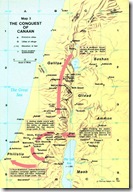
The_Conquest_of_Canaan

A request came to me to provide an answer to the question of the Canaanite conquest, and how do we square that with the idea of a loving God (for background on this, go to Dan van Loon’s posts here and here). But having said that, I am now finishing the study I started earlier on this topic, so I will try to share a bit of my conclusions.

A. Is the war of conquest against the Canaanites Jihad? Genocide? Ethnic cleansing? We need to understand that what occurred in the books of Joshua and Judges was not Jihad. Let me explain.

According to the most Muslim traditionalists, the world is divided into two camps:

  1. The House of Islamic Peace (Dar al-Salam), where Muslim governments rule and Muslim law prevails.
  2. The House of War (Dar al-Harb), which refers to the rest of the inhabited world.

The presumption is that these two camps will compete and that fighting is inevitable. Therefore the duty of Jihad will continue, interrupted only by truces until all the world either adopts the Muslim faith or submits to Muslim rule. Those who fight in the Jihad qualify for rewards in both worlds — treasure in this one, paradise in the next. From the lifetime of the Prophet Muhammad onward the word Jihad is used in a primarily military sense.

Commonly, Jihad requires Muslims to “struggle in the way of God” or “to struggle to improve one's self and/or society.” The four major categories of Jihad that are recognized are:

  • Jihad against one's self (Jihad al-Nafs),
  • Jihad of the tongue (Jihad al-lisan),
  • Jihad of the hand (Jihad al-yad),
  • Jihad of the sword (Jihad as-sayf).

Islam focuses on regulating the practice of Jihad. It is a call to all Muslims to engage in this struggle, ongoing and intentional. You will hear of fundamentalist Muslim groups who will declare a Jihad against a group or country (such as Al Qaeda against the US), but this is an extension of the central idea of Jihad.

Put simply, Jihad is a struggle that every devout Muslim is called upon to wage against the enemies of Allah. It is ongoing, and will not end until the conditions discussed above are realized. The best that the enemies of Islam can hope for are truces. The ultimate goal is submission of the world to Allah and the rule of Islam.

It is important to note that Jihad is mandated by Allah through the Qur’an, but it is declared by people (e.g., leaders), who also identify who the enemies are to be.

B. The focus in Scripture is on Yahweh war, or as it is incorrectly called, “holy war.” The term refers to war sanctioned by Yahweh (usually translated in our bibles with the phrase LORD, all capitals). But we need to note some important differences.

The conquest (and hence Yahweh war), was a single event, a unique event and limited event, lasting one generation, and was not meant to be a model of how future generations of Israelites should live and behave toward their contemporaries. It was an act of God, a call to take part in the Yahweh war. Yahweh war is not a feat of military prowess by the Israelites, or even their victory.

C. Genocide is a word sometimes used to describe the Conquest of Canaan. Genocide means the killing of an ethnic or culture group. In current usage, it is based on vicious self-interest, based on some view or myth of racial superiority, and is little more than ethnic cleansing.

The conquest of Canaan is never seen as ethnic cleansing, or as a mark of moral superiority. Nor is the action of Israel seen as a mark of oppression.

It seems, therefore, that we need to define our terminology. Jihad and genocide are not the same concepts as Yahweh war. To define the conquest of Canaan in these terms misses the point and clouds our understanding of the events. Our discussion can now move into the arenas of philosophy and theology.

When we do this, we find that there are no simple answers for this question. But a comment by N.T. Wright about the Conquest in his book Evil and the Justice of God (IVP, 2006) seems a good place to start:

“We look back from our historical vantage point – and post-Enlightenment thought has looked back from its supposed position of moral superiority – and we shake our heads over the whole sorry business of conquest and settlement. Ethnic cleansing, we call it; however much the Israelites had suffered in Egypt, we find it hard to believe that they were justified in doing what they did to the Canaanites, or that the God who was involved in this operation was the same God we know in Jesus Christ.

And yet ever since the garden, ever since God’s grief over Noah, ever since Babel and Abraham, the story has been about the messy way in which God has had to work to bring the world out of the mess. Somehow, in a way we are inclined to find offensive, God has to get his boots muddy and, it seems, to get his hands bloody, to put the world back to rights. If we declare, as many have done, that we would rather it not so, we face a counter-question: Which bit of dry, clean ground are we standing on that we should pronounce on the matter with such certainty? Dietrich Bonhoeffer declared that the primal sin of humanity consisted in putting the knowledge of good and evil before the knowledge of God. That is one of the further dark mysteries of Genesis 3: there must be some substantial continuity between what we mean by good and evil and what God means; otherwise we are in moral darkness indeed. But it serves as a warning to us not to pontificate with too much certainty about what God should and shouldn’t have done” (pp. 58-59).

Wright is saying that there must be a consistent understanding between what God understands as good and evil and our understanding of good and evil. If we judge the conquest of Canaan from our human, philosophical, ethical, moral standards in a way that is not based on God’s understanding of good and evil, we can very easily be presented with a moral and intellectual gap that may seem insurmountable.

In light of this, there are several questions we can address in the discussion in this issue:

  1. We have already discussed how the issue of Jihad in the context of Islam relates to the books of Joshua and Judges, whether it is the same thing as Jihad. How can we understand the idea of “holy war” in Joshua, can we see it as morally justifiable, yet condemn Jihad in the Islamic context?
  2. What of the philosophical-ethical issue of the conquest? Can we ponder it through our 21st century mindset, which leads us to interpret the conquest as ethnic cleansing or something similar?
  3. How can our understanding of the conquest square with the historical, grammatical situation of event, i.e., how did the Joshua and the people of Israel understand about the conquest?
  4. What are the theological issues attached to the question of the conquest? Can God’s command to destroy the Canaanites be seen as a viable command, something that had to be obeyed?

The discussion above is not an attempt to assuage the reality of the discussion, or pretend to offer a defense or apology for the conquest. It is merely an attempt to define our terms.

For my part, although the conquest doesn’t completely set with my view of the world, I do understand that we have to look at the event from the world perspective of ancient Canaan, and deal with the issue from that perspective, and not force our 21st century world view upon the event.

From there, I understand the event of the conquest in terms of God’s dealing with the Israelite people. This event wasn’t something out of context and out of character with God’s overall plan. As Wright says above, this is one of those times that God saw the need to get his boots dirty and his hands bloody in order to put the world to rights.

More to come.

name

Technorati Tags: ,

01 September 2009

15 Theses by Wolfgang Simson (Part 3)

3. The Third Reformation.

In rediscovering the gospel of salvation by faith and grace alone, Luther started to reform the Church through a reformation of theology. In the 18th century through movements like the Moravians there was a recovery of a new intimacy with God, which led to a reformation of spirituality, the Second Reformation. Now God is touching the wineskins themselves, initiating a Third Reformation, a reformation of structure.

4. From Church-Houses to house-churches

Since New Testament times, there is no such thing as "a house of God". At the cost of his life, Stephen reminded unequivocally: God does not live in temples made by human hands. The Church is the people of God. The Church, therefore, was and is at home where people are at home: in ordinary houses. There, the people of God:

  • Share their lives in the power of the Holy Spirit,
  • Have "meatings," that is, they eat when they meet,
  • They often do not even hesitate to sell private property and share material and spiritual blessings,
  • Teach each other in real-life situations how to obey God's word, dialogue, not professor-style,
  • Pray and prophesy with each other, baptize, `lose their face' and their ego by confessing their sins,
  • Regaining a new corporate identity by experiencing love, acceptance and forgiveness.

Technorati Tags:

A philosophy of education and experience?

JDewey.jpg (337×449)

John Dewey proposed a philosophy of education that focused on traditional education (education from without) and progressive education (experience, education from within). Traditional education focuses mainly on content, but it can become a “banking concept” for the transfer of knowledge.

Progressive education (education from within, or experience) is the other school of thought. Basically, it is grows out of our life experiences; but without sufficient or proper content, it will do little to offer growth or development. For Dewey, there needed to be a proper tension between education and experience.

As an educator in the church, I think we need the tension between what we are taught and what we experience in our spiritual formation. Teaching that is little more than throwing words out to the learner and hope that somehow they will appropriate them and figure out what we need to know and put into practice is not much use, either to the learner or to the body of Christ . 

Our preaching and teaching needs to educate us (think of it, if you will, as providing the raw materials), it should also provide guided, practical experiences that will help us to understand and assimilate what we have learned and how to apply it to life in order to promote growth and development in our spiritual formation.

Next time: What are we to teach?